The commentary is all over the map, and I link below to everything I came across—over three dozen takes and counting! Much of the debate quickly devolved into the typical dunking, defending, and sides-taking. But let that not obscure the opportunity this moment provides for the education reform movement. That’s Conor Williams’s plea, and he’s right. He emailed me to say:
Reformers should focus their energies (especially as the initial dust settles from the piece) on the substantive opening that Hannah-Jones offers with this piece. She provides a clarion example of how in-school actions matter for kids. Reformers know this. We’ve always known this. We’ve spent years knowing this and insisting on this and yelling about this...but so many of our critics have argued that schools can’t possibly overcome the effects of poverty, racism, parenting, whatever....
Like Waiting for Superman, like “The Rubber Room,” like ANation at Risk, et al., Hannah-Jones’s piece is an opening to remind the American public that schools matter and can be improved. And her piece is uniquely valuable in this moment because she’s been a hero for many reform critics—particularly highly-educated urban families. She’s giving us an opening to explain to those folks how we reform schools to clean up messes like what Najya experienced. We should take it!
To that end, my favorite reactions were those that focused on Nikole’s reporting—the gobsmacking details about the dysfunction in her daughter’s schools. And reminded us that high-poverty schools need not be terrible.
The teachers unions, by making bad teachers unfireable, are the primary obstacle to improving schools. Consider who the villains in Najya’s story are. They are the teachers who did not assign homework; the teachers who didn’t show up to class; and the teachers who “often rewarded...the ‘problem’ students for doing the littlest things right” (meanwhile, the students who always did what they were supposed to went unrecognized); the teachers who “stopped calling on her” in class; the staff who sat by idly as kids tore each other apart in the cafeteria; the absentee principal who couldn’t be bothered to respond to emails. All of these people are protected by the union, unfireable except for the gravest of offenses.
And
Although most of the lessons to be drawn from Hannah-Jones’s essay apply to progressives, the political right does not get off scot-free either. Consider the argument of the hereditarians. The lesson that many people draw from the work of scholars like Charles Murray and Nathan Cofnas is essentially, “We’ve tried everything to raise the test scores (including IQ) of blacks and Hispanics, and nothing works.”
…In light of accounts like Najya’s, how confident are we that we’ve tried everything? Have we tried a nationwide dose of schools that actually assign homework, where teachers show up to class every day, where disruptive kids are removed, where lunch is actually served, where principals who don’t respond to emails get fired and replaced? Have we ever tried a nationwide dose of what wealthier kids would consider a basic education? And if we haven’t, then how can the hereditarians be so confident?
There is good reason to think we haven’t, because when someone has tried, it has worked. Roland Fryer, for instance, took over some of the lowest-performing public schools in Houston, imported commonsense policies from the most successful charter schools, and produced real, measurable test score gains. If every poor student in America got this kind of education K–12, it’s hard to imagine our country would not be in significantly better shape on every question of racial inequality.
Hannah-Jones’s essay about her daughter’s education is remarkably candid. She describes choosing schools that reflected her commitment to racial equality, watching them fail to educate her child, and confronting the possibility that she had sacrificed her daughter to her principles. That is difficult for any parent to admit, especially a public figure whose professional identity is bound up with those principles.
I admire her honesty, and I understand the conflict. I chaired the New York City Council’s Education Committee and, in 2006, founded Success Academy, the public charter school network I still lead. I am also the mother of three children. I wanted to do what was best for them while reflecting what I publicly urged other families to do. But what happens when those goals collide?
I faced that dilemma in 2008. Two years earlier, I had moved to Harlem to be near the school I had founded and because we could afford a home there. On the Upper East Side, which I represented in the City Council, we had been raising three children in a one-bedroom apartment.
Harlem had affordable housing but weak public schools. When my son Dillon reached kindergarten age, we had him tested for Hunter College Elementary School, but he didn’t get in. For years, I had railed against the lack of good schools in poor neighborhoods. Suddenly, I was one of those parents without a good option.
As it happened, I was opening three new schools in Harlem. I had deliberately set about creating schools to which I would send my own children. But having that goal was one thing; betting my children’s education on achieving it was another.
For me, as for Hannah-Jones, decisions about where to educate my children were never entirely private. I had spent years asking other families to trust these schools. Now I had to decide whether I would place that same trust in myself....
Both children remained at Success Academy through high school. Here my story diverges from Hannah-Jones’s: I do not believe I sacrificed their education. There were social costs, but academically, I believe they received an education better than the one available at even New York City’s most celebrated district schools.
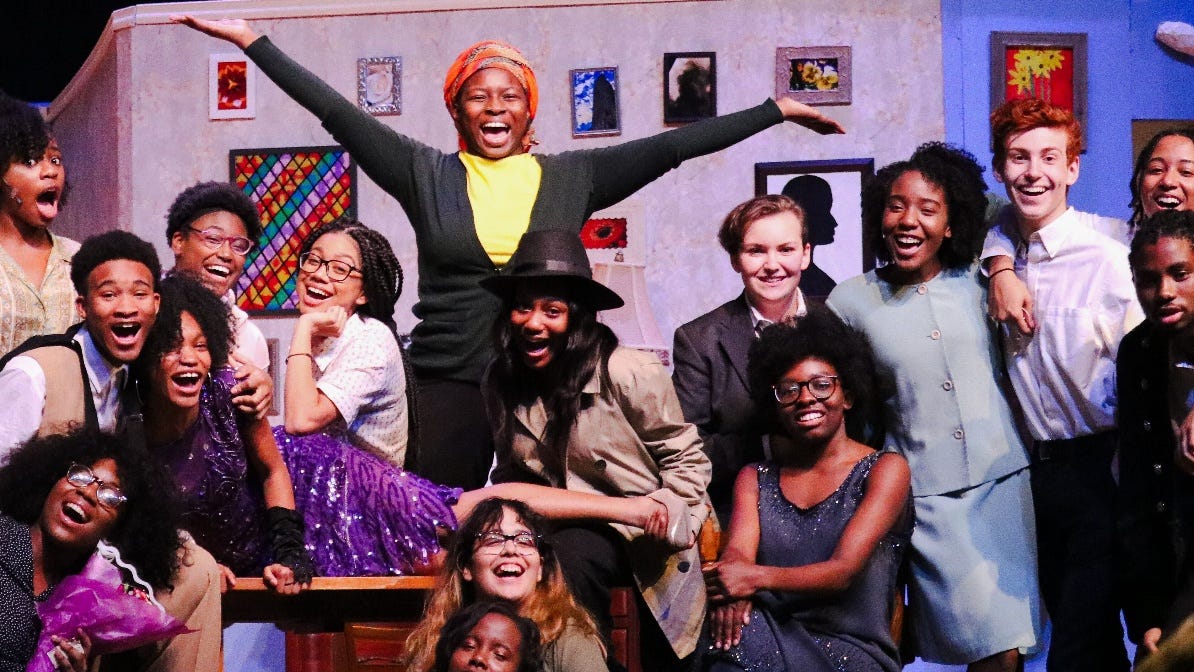
Moskowitz’s children, above: Dillon (third from right) and Hannah (sixth) with the cast of their high school’s 2018 production of “You Can’t Take It With You.” Photo: Success Academy.
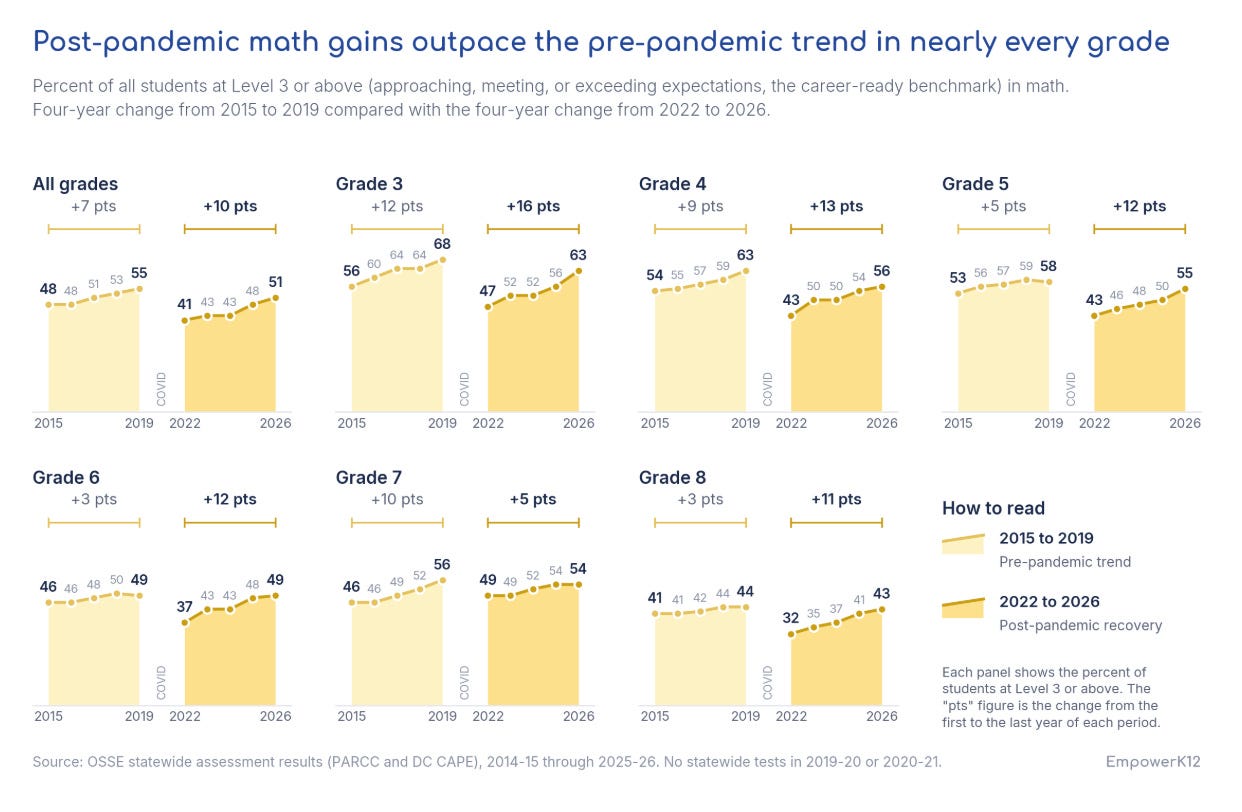
We can also look to schools in Washington, D.C., to see that it’s possible to run good public schools, even within traditional urban districts. Despite poverty, despite segregation, despite everything. That’s the message from Matt Yglesias, who has sent his own sixth-grade son to Title I schools in DCPS.
One key difference between our situation and Hannah-Jones’s is that while Washington, D.C., Public Schools (D.C.P.S.) was notoriously bad for a very long time, it’s been on a broadly positive overall trajectory.
Source: EmpowerK12 analysis of D.C. student assessment data from the D.C. Office of the State Superintendent of Education
Some of the gains at D.C.P.S. reflect the fact that more affluent parents have been enrolling their kids in public school, which has mechanically pushed the averages up. But we’re not looking at a pure compositional effect—D.C. has been showing stronger results across all the major demographic subgroups (I really recommend Josh Boots’s article for Capital Commonsense if you want a detailed rundown of all the good news).
Why have the schools in D.C. gotten better?
I think it’s broadly because under ex-Mayor Adrian Fenty a contentious new “reform” regime came into power under the stewardship of D.C.P.S. Chancellor Michelle Rhee, who became a national media celebrity thanks to her battles with the teachers union.
Fenty failed to secure re-election after one term, but his successor, Vincent Gray, replaced Rhee with her deputy, Kaya Henderson, who did not seek national media attention in the same way but essentially stayed the course.
This Fenty-to-Gray transition stabilized and consolidated the reforms, and then while current Mayor Muriel Bowser’s 11 years in office have been fairly uncreative on K–12 education, she hasn’t really done much to alter the positive trajectory.
Contrast that with New York City, which (except for its charter schools) failed to maintain the momentum of the Michael Bloomberg/Joel Klein years.
So, yes, we all wish that Nikole had come to the obvious conclusion: The way to fix the schools that failed Najya is to reform the system, from both the inside and the outside. In other words: school reform. She may never be willing to embrace our agenda, but her article will most definitely help make the case for it.
Here are the other 42 (!) articles that have been published about Nikole’s essay:
Constance Lindsay (drconstance) shares her quick thoughts on instagram, and encourages a deeper look at research for those interested in the complex issues raised in the piece.
Another take-away from @nhannahjones’s piece...if you, consciously or unconsciously, think “the smart kids will always be okay,” you’re wrong. The smart kids need attention and good instruction too.
Derrell Bradford (@Dyrnwyn): It’s a mistake to design public policy that requires someone to act against the best interests of their own children.
Marc Porter Magee 🎓 (@marcportermagee): While some are calling it misleading, I thought it was a bold literary decision by Nikole Hannah-Jones to imagine in her first-person essay an NYC without its 286 charter schools. It really heightens the tension.
Employers, and even employers in non-STEM fields, expect graduates of elite universities to be competent with basic math skills. If I were considering hiring a candidate who attended a UC school, Pawel’s op-ed is an extraordinarily strong argument that I should not consider their degree to be a credit to them. (Some majors are still rigorous, but they can’t all be if students are both less capable than ever and more likely to graduate than ever.) If you extrapolate this situation—with no test for academic readiness at admission and pressure to graduate everyone admitted—there will ultimately be no reason to believe a graduate of a UC school is any more qualified for a job than a person who never went to college.
I don’t think it’s hopium to say that the tide is turning when it comes to academic standards. And not just in our little ed-reform bubble. These stories about lowered standards are sparking real outrage, something we haven’t seen in over a decade. Keep it coming!
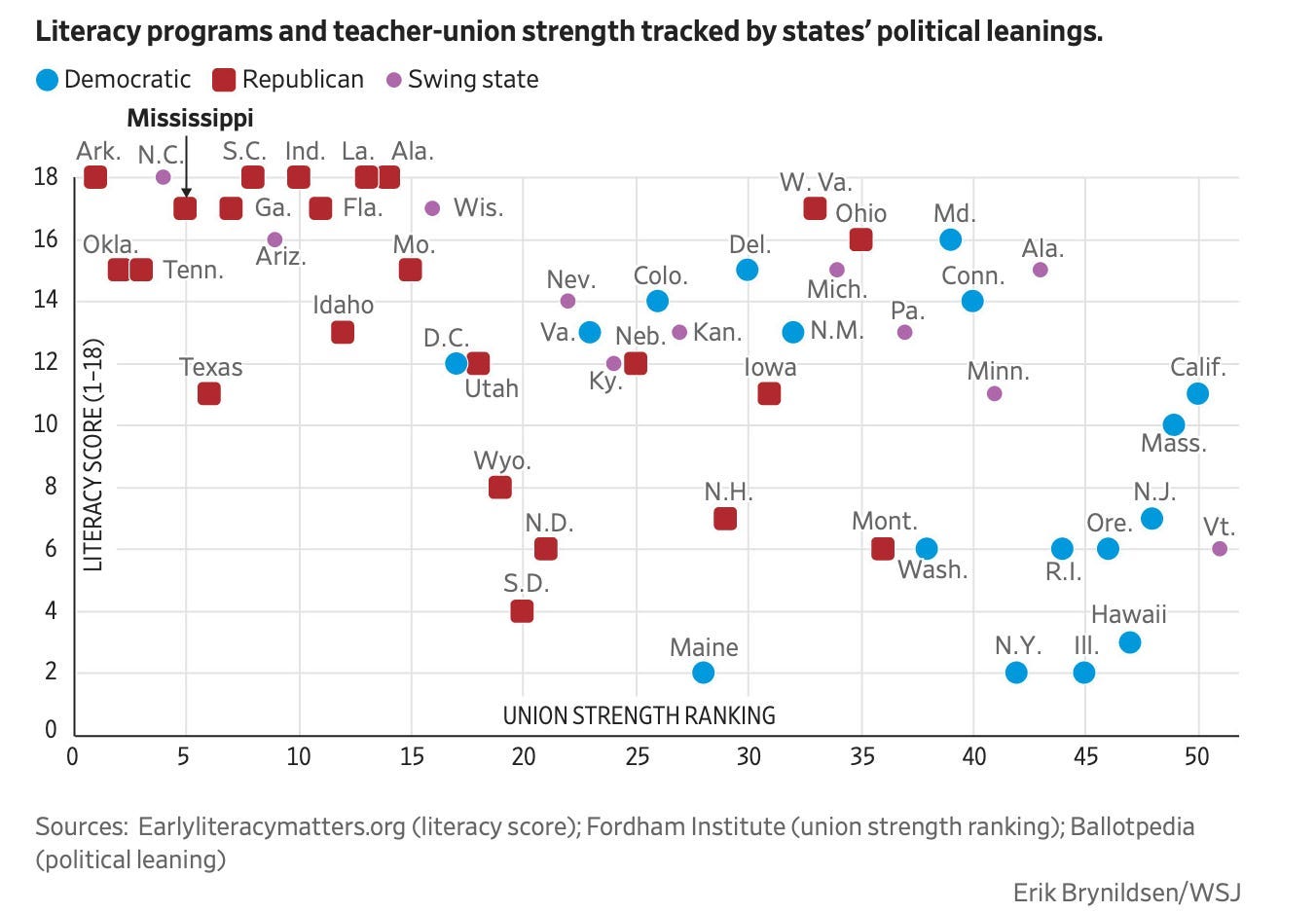
The other article making the rounds in the BN (before-Najya) era was Rachel Canter’s Wall Street Journal article (covered here at SCHOOLED) about how both red and blue states might emulate the Mississippi Marathon. What really went viral, though, was its chart comparing the political strength of each state’s teachers unions and the comprehensiveness of their science of reading policies, which bounced all over the interwebs and even showed up in Nellie Bowles’s widely-read TGIF column in The Free Press. First Nellie tells readers about another topic we’ve covered extensively here at SCHOOLED—New York’s boneheaded move to abandon the Regents Exams as a graduation requirement:
Here’s New York Board of Regents member Felicia Thomas-Williamson the change: “Maybe you’ve seen the cartoon where you have a fish climb a tree? You don’t assess a fish on climbing a tree because fish can’t climb trees.” If the Regents exam asked students to breathe underwater, then Felicia’s argument might track. But the exam asks students to read, write, and solve math problems—skills that are standard for most educated human beings. Or should be? Of course this test was dropped as a requirement for vaguely anti-racist reasons that no one bothered to really explain. But now: What will New York high school students have to prove in order to graduate? Will they just fill out a feelings wheel? Are they going to play Go Fish for 40 minutes and call it a day? That’s insane for the public school system. Playing games at school costs at least $50,000 at a private school in Santa Monica.
Tee hee hee.
Then Nellie compares New York to Mississippi:
There, when students fall behind, the state doesn’t tell teachers simply to throw their hands up in the air and say, “Reading simply isn’t one of this child’s natural talents, I’m asking a fish to climb a tree.” They notify the parents, hold the students back, and teach them again. It’s called the Mississippi Miracle but it isn’t really a miracle—it’s just deciding to get the job done. Anyway, this is a lot easier when teachers unions are weak. Here’s a WSJchart showing how reading scores* tend to be inversely correlated with teacher union strength.
It’s like the more power the teachers hold, the less the kids can read. Hmm!
I’ll say it again: It’s been a really good week for ed reform!
* And on Rachel’s behalf, I’ll remind you that the chart doesn’t look at reading scores but ExcelinEd’s ratings for each state’s literacy policies.
Speaking of teaching kids to read, England’s gotten really good at that, as illustrated by its improving PISA scores (yes, say it again: also covered extensively here at SCHOOLED). Now Robert Pondiscio and Sir Nick Gibb himself team up to offer lessons for America:
Ironically, the American scholar E. D. Hirsch Jr. has been a major influence on England’s approach. For decades, in books such as Cultural Literacy and The Schools We Need, Hirsch has argued that knowledge is not the enemy of critical thinking or reading comprehension but rather a prerequisite for both. Children from knowledge-rich homes arrive at school with an enormous, largely invisible advantage. Schools that do not ensure that children from low-income families acquire that wide range of knowledge across a broad curriculum are functionally imposing illiteracy on them.
Hirsch’s work, which has long been controversial in the U.S., helped shape England’s reforms. The nation’s 2014 National Curriculum put subject knowledge back at the center of schooling while generally granting schools considerable freedom over teaching methods. In essence, England began to treat reading as both a phonics code to be mastered and a body of knowledge to be taught and shared.
I love it. Also great: They published the article in the National Review, a sign that conservatives are open to curriculum reform, too, not just school choice and culture wars.
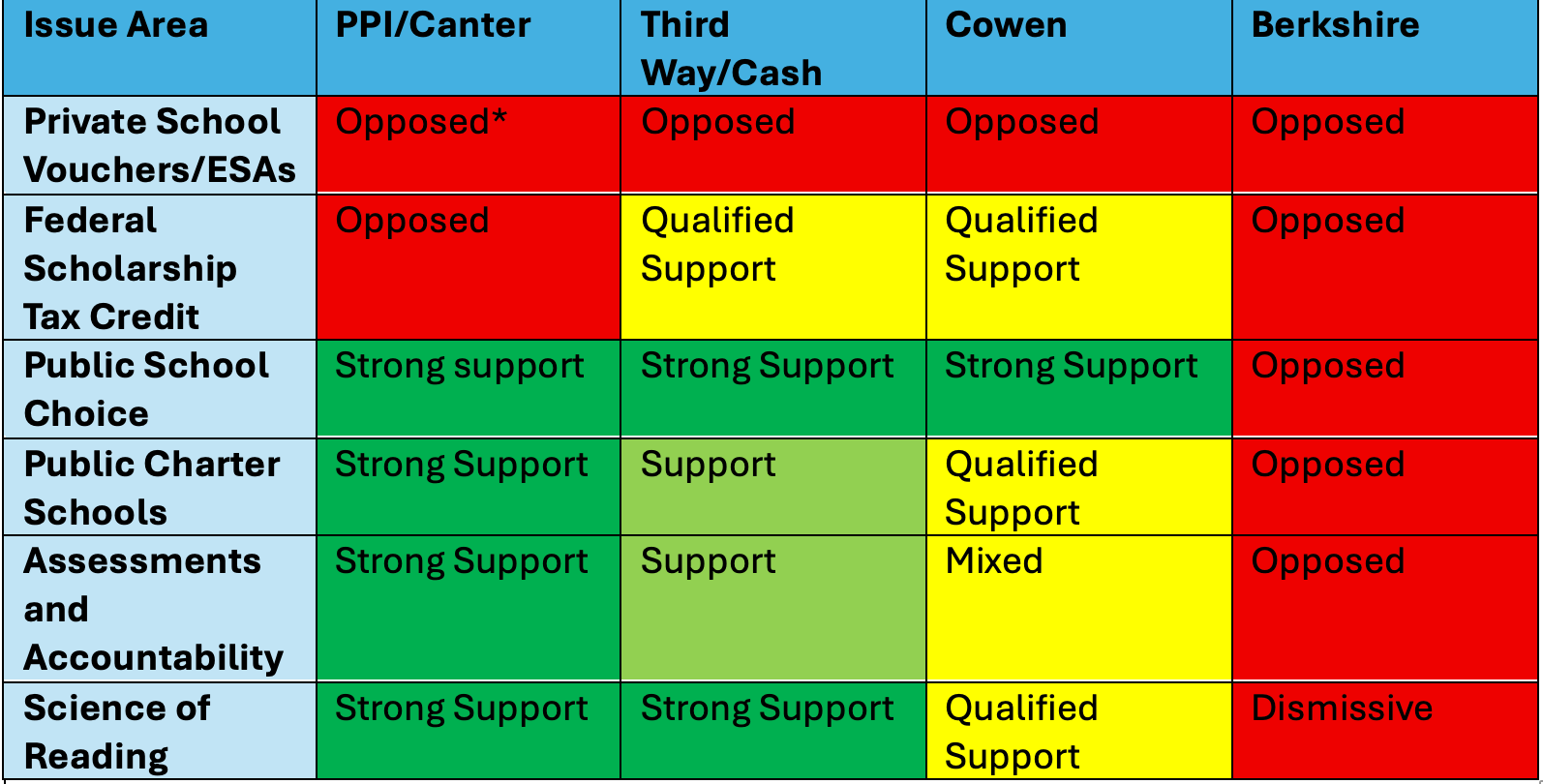
Charlie graciously notes that yes, we’ve coveredseveral of these here at SCHOOLED, but he goes into much more detail. And finds some common ground on some issues (like opposition to vouchers) and less on others (like testing and accountability). His table says it best:
We’d better pay attention because many political pundits see a blue wave coming, one that could usher in a Democratic House and Senate, but also more D’s in statehouses than seemed likely just a few months ago. Here’s hoping that at least some of them—R’s, too, of course, wherever they prevail—are willing to keep the growing reform momentum going.
Ariel Gilreathreports on South Carolina’s legislative efforts to curb grade inflation—efforts largely supported by the state’s teachers, and part of what may be a broader swing away from “no zeros” and grade-floor policies. “Once you’ve lowered the bar, it’s hard to raise it again,” notes David Griffith, co-author of Fordham’s 2025 report on equitable grading through the eyes of teachers. Cheers to leaders in the Palmetto State for taking action.
Amanda Geduld writes up The 74’s investigation and analysis of decades of sexual assault cases involving educators in New York. The painful-to-read piece describes the alarming frequency of abuse and how justice is often delayed or denied.
In May 2011, C.J. Huff was superintendent of schools in Joplin, Missouri, when the small city was hit by a violent tornado that killed 161 people, including seven students, and destroyed six schools and a large share of area housing. Eve Fairbanksdescribes how Huff’s decisive leadership helped the community rebuild its schools, and how that experience—including the toll it took on him personally—informs his current work helping communities through natural disaster recovery with little federal guidance.
See you next week.
Mike
Sign up to receive this newsletter in your inbox, usually on Friday mornings. SCHOOLED is free, but a few linked articles may be paywalled by other publications.
Amazing job creating that list of commentaries and responses to the Hannah-Jones’ courageous piece. Hugely important to keep the conversation going —and for drawing the right rather than predictable conclusions.






Here is my take https://cityjournal.substack.com/p/the-unmentioned-villain-in-nikole?r=kg901&utm_medium=ios
Amazing job creating that list of commentaries and responses to the Hannah-Jones’ courageous piece. Hugely important to keep the conversation going —and for drawing the right rather than predictable conclusions.