Today we debate whether states can lead on High-Quality Instructional Materials (HQIM) without disempowering educators, with comments from Kalman Hettleman, Robert Pondiscio, and Peter Greene. Then we round up the week’s edu-opinions from Jared Cooney Horvath, Rick Hess, Chad Aldeman, Jorge Elorza, Ben Austin, Jane Swift, Shaka Mitchell, Neal McCluskey, Colleen Hroncich, Josiah Padley, Brenda Dickhoner, Lindsey Phillips, and Matt Barnum.
Getty Images / Amy Sparwasser
On Tuesday, I described a live debate out there about whether all states should get more prescriptive around HQIM, as the Southern Surge states have done, or should leave those matters to local control. Now Kalman Hettleman and Robert Pondiscio suggest that perhaps there’s a both/and approach that can give us the best of both worlds. Let’s start with Kalman (a.k.a. Buzzy):
You pose a pivotal question about the state role over teaching and learning. I am strongly on the side of greater state control, and here are two thoughts about it.
In addition to looking at the experiences in Louisiana, Tennessee and Mississippi, eyes should now be on Maryland. Maryland’s state superintendent is Carey Wright who, as Mississippi state superintendent, led the “Mississippi Miracle.” Her Maryland literacy plan seeks to build on the Mississippi experience and, arguably, make Maryland the first blue state to pull off reform at scale.
A related thought: The debate over state control should avoid false dichotomies. It’s not either/or. Key is how to impose state standards and gain buy-in by local districts and classroom teachers. This is a focus of the Maryland effort, and here’s hoping it succeeds.
Robert seems to agree, and thinks there’s a way to keep a role for both the state and localities. On X, he offers an analogy:
Folks will bridle at the comparison, but one way to think about the state vs. local control conflict Mike Petrilli perceives on curriculum is to compare it to franchising a fast-food restaurant. Your neighborhood Subway or Dunkin is a locally-owned business. But you can’t open a McDonald’s and decide your customers really want tacos. You have limited control over menu, pricing, and ingredients, but retain significant autonomy over day-to-day operations like staffing and local marketing.
Peter Greene, though, isn’t buying it. He writes:
The folks in state capitals are far better at politics than they are at education. That’s how they got there. Even when they pretend to consult actual classroom teachers, they will select for teachers who are good at politics and align with what the folks in the state capital already think they want to do. “We talked to hundreds of actual teachers and realized we were headed in exactly the wrong direction, so we have changed our direction and emphasis,” said no state-level edu-bureaucrat ever.
From the state capital to the classroom involves a game of telephone. At every level, the person charged with passing on the state directive somehow hears what they personally believe is The Answer for education (or they just don’t understand it). In almost forty years, I lost track of how many times I had this conversation:
Trainer, superintendent, state bureaucrat: The new initiative shows that you should be doing X in your classroom.
Me: I’m looking right at the new state regs and I don’t see anything here that mandates X.
TSS: No, it definitely means that you should be doing X.
I mean, seriously—did we learn nothing from Common Core?
What do you think? Is it just happy talk to say that we can have strong state leadership on curriculum and teacher buy-in? Or is the path to success figuring out how to accomplish exactly that? Weigh in by commenting, responding to this newsletter, or emailing me at SCHOOLED@fordhaminstitute.org.
Rick: You report that, on PISA assessments, students who use computers more than six hours a day score 66 points lower than nonusers. How big a deal is that? And what do you think is going on?
Jared: On the PISA scale, 66 points is a very large difference, roughly two-thirds of a standard deviation. In practical terms, that’s equivalent to dropping from the 50th to the 24th percentile, or roughly two letter grades. What’s particularly striking is that this pattern holds across every country tested by PISA. My interpretation is that we’ve gradually outsourced significant parts of thinking and learning to digital tools. When adults rely on Google Maps for navigation, their navigational skills fade. The same principle applies in education: When students rely on software to generate, process, and organize information, their cognitive skills and learning begin to fade as well.
And there’s little doubt that the skills of both adults and students are fading. Jared explains:
On average, each generation gained about six IQ points compared with the one before. That was known as the Flynn effect. In the last 15 years or so, however, the Flynn effect has reversed. Across many measures—from literacy and numeracy to basic working memory and attention—performance has declined among the youngest generation. Although there are likely several contributing factors, when you look closely at the timing of the reversal, one development stands out: the widespread integration of digital technologies into nearly every aspect of young people’s lives, including school, in the early 2010s.
But perhaps we shouldn’t be so quick to blame ed-tech for our educational woes. Cue Chad Aldeman, who digs into data from Jared and others to question whether screens are responsible for America’s achievement declines. Chad’s conclusion: Maybe? After all, there are plenty of other culprits to point to, including the evaporation of K–12 accountability. Plus, as Meredith Coffey and others have argued, not all screens in schools are bad. (Chad references Mark Rober’s great YouTube science videos, for example.)
But Chad’s also skeptical about Jared’s read of the evidence. Akin to his take on PISA, Jared has also dug into NAEP scores, and presented them in a Senate hearing, arguing that they too show the deleterious effects of ed-tech. As states hit what Jared defines as a “digital inflection” point, their scores tend to slump. Chad writes:
I don’t think we should be satisfied with fuzzy correlations like this. In fact, if you look closely at [Jared’s] graphs, you can see that achievement scores had already started to plateau before what he calls the “digital inflection” point. It’s hard to blame technology for a trend that started beforehand.
Furthermore:
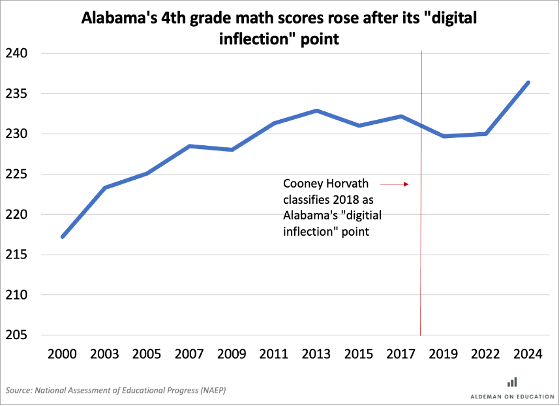
Just to pick a convenient example from the top of the alphabet, consider Alabama. [Jared] codes 2018 as the year that Alabama passed its “digital inflection” point, “corresponding to the first operational period in which statewide accountability assessments were administered through fully computer-based platforms as the default testing mode.”
And yet, look at Alabama’s fourth grade math scores on the National Assessment of Educational Progress (NAEP). Its scores dipped slightly from 2017 to 2019, but they stabilized and then rose from 2022 to 2024. If technology were the main driver, we’d expect consistent declines after adoption.
Granted, we could make the same case against the correlational evidence demonstrating that the end of consequential accountability was to blame for our NAEP declines. (In fact, Freddie deBoer did exactly that, though not well, IMO.)
The screen time argument should be seen as a hypothesis, not a fact. And given those Flynn Effect results for adults—who clearly haven’t been harmed by technology in the classroom—we should also investigate the damage that screens outside of schools are doing to our kids. That might matter more—but it’s a problem that’s a lot harder to solve.
Once the populist force—suspicious of institutions and champions of those too often overlooked and left behind—the [Democratic] party is now widely perceived, and increasingly operating, as the party of elites and institutional insiders. Meanwhile, Republicans, long the party of the establishment and elite-oriented, have absorbed the populist energy that once defined the left.
Nowhere is that reversal more glaring or more costly than in America’s K–12 schools. Since the end of the Obama years, Democrats have defended the system despite evidence of mounting failure…The party has deferred to administrators, shielded unions and told frustrated families to trust a system that has repeatedly failed their children.
They suggest several solutions including trusting parents by embracing school choice; closing the “culture gap” by moderating on trans issues; focusing on results; listening to voters instead of teachers unions; adopting an “abundance mindset,” including on charter schools; and building a bigger tent.
In fact, they built such a big tent with this policy agenda that most Republicans I know would easily fit inside it!
In the past, efforts to adopt new measures have been thwarted by federal regulatory constraints and limited technological capabilities. But many of those longstanding barriers to innovation are disappearing. Today, artificial intelligence makes the need for repositories of test questions a vestige of the past, instead automatically adjusting difficulty levels based on a student’s answer. And speech recognition allows a once unimaginable capture of early literacy progress—even for children who cannot yet take a test.
Perhaps most importantly, the current administration has made clear that states now have the flexibility to explore new options.
Governor Swift, I’m with you on the speech-recognition software—it means we can effectively test children in grades K–2, which states and NAEP should definitely start doing. But are we really going to let Claude write test questions? What do y’all think?
James O’Toole, a leadership scholar, developed a framework he called the Executive’s Compass. O’Toole argues that every major political conflict in democratic societies maps onto four values: Liberty, Equality, Efficiency, and Community. These are not left and right. They are all genuinely good, and they are genuinely in tension with each other.
Furthermore:
The important thing O’Toole observes is that most of us hold all four values simultaneously, but we hold them in different proportions. When these values conflict, how we rank them, and how others rank them, is crucial for reaching consensus on a solution. A policy or initiative that only speaks to a single value is unlikely to endure. The education solutions that actually gain traction are the ones with a tent big enough to make room for all four.
Shaka makes a compelling argument that school choice advocates have learned to speak the language of all four values, while proponents of other reforms (like year-round schooling) have not. It’s a useful framework; allow me to apply it to my current favorite policy, Texas’s Teacher Incentive Allotment:
Liberty. It’s optional for districts to participate, and teachers who are designated as highly effective can take their extra dollars to other districts.
Equality. The big bucks go to teachers serving in high-poverty schools.
Efficiency. The program is very affordable, in part because it’s very selective about which teachers qualify for additional pay. And it’s automatic, baked right into Texas’s funding formula.
Community. The biggest impact is on rural schools, which are desperate to hang on to great teachers, who are a big part of their schools and the larger community.
Now it’s your turn. What other reforms fit?
Speaking of school choice, Neal McCluskeyexamines the claims Cory Turner made in a recent NPR segment about the impact of school choice on the public schools of Cedar Rapids, Iowa. It’s an excellent work of media criticism. Here’s my favorite part, referring to the contrast Cory made between traditional public schools and Iowa’s expanding list of educational alternatives:
The celebration of schools that “take everyone” gets further muted when one reads why parents are taking their kids out of the Cedar Rapids schools: disorder.
“Last school year, the district recorded nearly 4,000 incidents that led to a suspension or expulsion,” NPR reports. “That’s a lot of disruption, considering this punishment is meant to be reserved for the most severe behavior.”
It is also a lot considering total enrollment in the district is only around 16,000 students.
That public schools must retain disruptive students is not a good thing, and keeping them out, as some private schools do, is. Retaining students intent on not learning, who also prevent others from learning, is helpful to no one. Of course, one thing alternative campuses are supposed to provide are landing spots for disruptive children, so the district might, to some extent, be dealing with the problem. But, at the very least, not sufficiently to keep the families that have gone private or charter from leaving.
The spread of educational freedom programs has opened new options for teachers. This includes jobs at traditional private schools, but the opportunities don’t stop there. Former public school teachers are among those taking advantage of these programs to create microschools, small learning environments that often follow a student-centered model and group kids by their needs instead of just their ages; hybrid schools, where kids learn in person some days and at home others; and à la carte options, where they offer specific content to homeschoolers or microschools.
Josiah Padley would surely agree but adds several ideas to the teacher appreciation mix. Among them: Paying teachers well; allowing them to discipline unruly students; rejecting “‘standards-based grading’ or other new grading methods that bar participation grades and zeros.”
Teachers need (and want) strong administrative support when they do give poor grades to students who have earned them. Grades are an important communication tool between teachers and parents, and teachers need to feel they can be fair, honest, and consistent.
Wrapping up our school-choice round-up, Brenda Dickhoner celebrates the defeat of a Colorado bill that would have hampered the adoption of President Trump’s Education Freedom Tax Credit (EFTC) in the Centennial State. Here’s a compelling argument for the EFTC that I had not seen before:
Education as a jobs program: Where have I heard that before?
Speaking of jobs, one of the thorniest issues states face as they embrace career-oriented pathways for high school students is how to value the industry credentials that increasing numbers of kids are earning. There are literally millions of these things, most of which are worthless but a few of which are golden tickets to opportunity and good-paying careers. How can states tell the difference? Lindsey Phillips explains that new studies from Texas and Ohio can point the way.
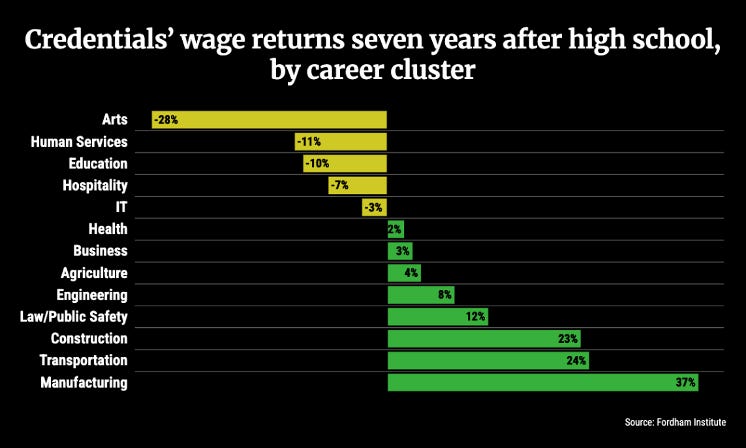
Research from Ohio finds that while some of the certifications offered in the state deliver long-term value, others do not. For example, certifications earned in the manufacturing industry led to stronger income and employment potential than those in fields such as education, human services, or the arts. Findings from Texas tell a similar story. Students who graduated between 2017 and 2022 now see as much as 35 percent higher earnings or up to 30 percent lower earnings depending on the credential they attained.
I’m proud that the Ohio study Lindsey is referring to comes from the Fordham Institute’s Columbus office. In The 74, my colleague Aaron Churchill teams up with study author (and Ohio State professor) Jay Plasman to explain what others can learn from the Buckeye State:
Our study revealed that students who both attain credentials and complete a sequence of career-technical coursework reap larger wage returns than students who attain only a credential or do not participate in any career-focused education. This suggests that states’ accountability systems should count students as career-ready only if they both complete coursework and obtain an aligned credential…
In Ohio, the credentials that provide the strongest and most enduring wage gains—lasting into people’s mid-20s—are linked to the transportation, manufacturing and construction industries. By contrast, credentials across a dozen other career fields provide no enduring wage returns. Policymakers should prioritize credentials that yield strong long-term economic payoffs. They should also be wary of approving credentials that lack a clear link to a specific occupation—for instance, a basic job-safety certificate versus a certified welder license—or those that might inadvertently encourage students to pursue low-paying jobs with limited opportunities for advancement.
Paying attention to these details is critical both when designing high school accountability systems and when setting graduation requirements for students pursuing a career-oriented path.
Jaden Edison shares updates on the rollout of Texas’s massive new ESA program: As of this week, about 96,000 Texas students received notice of their eligibility. Most of the vouchers will go to students with disabilities and their siblings, and to kids in families making less than $66,000 per year. —The Texas Tribune
“The federal government has been collecting and sharing basic facts about schools since 1870; the Digest of Education Statistics began in 1962. The Digest has marshaled a vast array of data to offer a comprehensive picture of the sprawling, decentralized American system of education,” writesMatt Barnum. After DOGE cut contracts last year, the Department of Education stopped updating key data tables that provide “easily accessible, relatively up-to-date information about the basic realities of American schools.”
“The role of the national government is to collect statistics on K-12 [education],” said Amber Northern, the Fordham Institute’s vice president for research who is on contract with the Education Department to suggest ways to improve its statistical work. “Absolutely the Digest is integral to that. And we need to get it restarted.”
“For a subset of the wealthiest, being able to afford to raise children in a city—especially lots of children—has become a financial flex,” says sociologist Ness Sandoval. It’s a trend that impacts the nature of urban schooling, driving up competition for seats at the most selective public schools. —The Economist
Have a great weekend,
Mike
Sign up to receive this newsletter in your inbox, usually on Tuesday and Friday mornings. SCHOOLED is free, but a few linked articles may be paywalled by other publications.
The state of state curriculum lists says: it's just happy talk. I need a whole Substack post to explain/defend that statement, but spoiler alert: a close look at state curriculum lists now (something that the commenters in your newsletter seem to be failing to do, curiously) will make even the most hard-charging EdReformer disavow state lists.






The state of state curriculum lists says: it's just happy talk. I need a whole Substack post to explain/defend that statement, but spoiler alert: a close look at state curriculum lists now (something that the commenters in your newsletter seem to be failing to do, curiously) will make even the most hard-charging EdReformer disavow state lists.
Watch this space.