


Hello, friends. If you’re like me, you’re probably in a somber mood this morning, reflecting on the fateful day 25 years ago—especially if, also like me, you’re old enough to remember it. (I was on my honeymoon in Italy, thus avoiding much of the trauma that my Department of Education colleagues experienced that day.) I’ve read several lovely—and heart-wrenching—essays about 9/11 this week, but I commend this one from Peggy Noonan in particular. One passage:
On 9/11, my 14-year-old son was in his second day at a new school just across the East River from the towers…. He didn’t come home that night, that 14-year-old boy, but stayed, with other students, in the Brooklyn house of a teacher. The next morning he took a patched-together, roundabout subway route back home to Manhattan, and the train came up from a tunnel and started to curl north. At that point, he was told, riders would always look left, just for a second, at the towers and the gleam of downtown Manhattan in the sunlight. And that morning everyone turned as usual and saw the debris cloud where the towers had been. And from everyone in the car came a soft collective sigh, a groan, an ohhhhhhh. There was a big man, a union guy, tough, standing in the middle of the car, and he looked with everyone else, and then lowered himself to a seat and began to cry.
We will never forget.


Back in April, Rick Hess interviewed Michael Horn for his Ed Week blog and gave his post the provocative title, “Schools Are Urged to Embrace AI—and Ban Phones. Can We Resolve the Tension?” We now know the answer is yes—we can resolve the tension by banning AI, too! That’s what New York City (for grades K–8) and Los Angeles (for K–12) have recently announced that they’re doing—at odds with Michael’s advice:
We should be very wary about promoting blanket bans. Not only is it out of tune with the reality that some parents are intentionally opting for schools that leverage AI, but it will also limit the use in cases where ed tech makes sense in traditional schooling models.
I think it’s fair to call Michael a techno-optimist, but he’s got the DNA of an old-school education reformer, wanting to see results in terms of improved student achievement. And he thinks AI might deliver. For example, Michael says:
Dacia Toll, who founded Achievement First and is no stranger to rigor in schools, is using AI to build Coursemojo, a curriculum-aligned teaching assistant for English/language arts. Most importantly, she’s doing so with clear instructional design, guardrails, clarity around the importance of knowledge, and human teachers setting the rules around what good instruction, good questions, and actual student misconceptions look like. I think we’d be foolish to dismiss the opportunities that someone like Dacia sees in these tools.
Others with close ties to the ed-tech and AI worlds, like Ben Wallerstein at Whiteboard Advisors and Erin Mote at InnovateEDU, urge education leaders not to throw out the baby with the AI bathwater.
And I get it—let’s embrace the good stuff while pressing delete on the bad, rather than tossing it all aside. That makes sense. And Erin, at least, claims that New York’s moratorium embraces a bit of nuance:
If you read past the headlines, N.Y.C. is not running away from the future—they are creating a disciplined testing ground. It is critical to note that the district spent the last three years revising its Enterprise Request Management Application (ERMA) process to ensure privacy, security, and interoperability. That rigorous vetting creates a strong foundation for building an evidence architecture. Piloting five purpose-built edtech tools in schools, the district is working to measure pedagogical impact and learning outcomes. Bringing together researchers, educators, parents, and advocates over the next year will create a foundation for discovering what works, for whom, and under what conditions.
She still wishes N.Y.C. hadn’t pressed pause. Even the American Psychological Association says that bans are too extreme. But it’s tough right now to be the one making the case to “trust the system,” the more so as recent Silicon Valley exiles warn of a catastrophic future resulting from runaway AI. And for parents frustrated with the invasion of technology into our schools, it’s hard to argue that our schools have leaders at the helm who will steer clear of questionable products or practices.
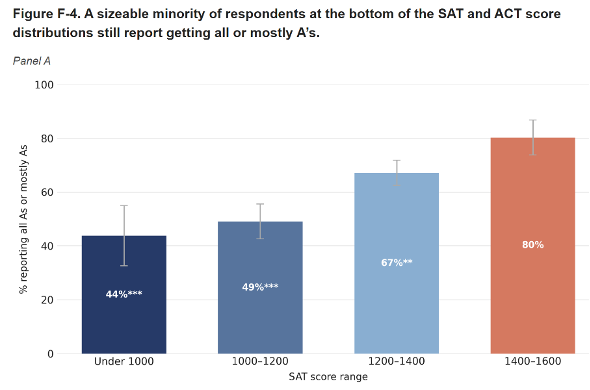
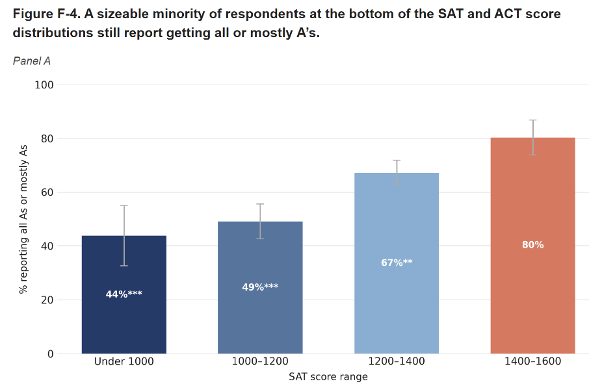
And not just parents—even students themselves are screaming from the rooftops that pervasive screens, cheating-enabling AI, and an erosion in grading standards are cratering academic expectations in their schools. That’s the takeaway of a new Fordham Institute report by my colleague Brian Fitzpatrick, based on polling by Impact Research and UpONE Insights. Among the more noteworthy findings:
76 percent of students report some sort of illicit tech use at school, often on school-provided Chromebooks or iPads.
26 percent of students report using AI to cheat on tests or quizzes.
Most student say they spend the majority of class time on school-provided devices.
And weak grading standards make distraction and AI misuse worse; even students with very low test scores report getting all A’s.
Call me a Luddite, but I can’t help but read these findings and want to throw out the baby, the bathwater, and the tub, too. Let’s get back to paper and pencil—and human thinking and relationships—and make our schools tech-free zones! (And bring back C’s, D’s, and F’s while we’re at it.)
Maybe that’s too extreme. But how should we decide? Halina Bennet at Matt Yglesias’s Slow Boring Substack wrote a great piece the other day, teeing off a new report from M.I.T. about “AI Use in Teaching, Learning, and Research Training.” Its analysis is helpful for K–12 schools too, Halina writes:
Public K-12 systems are designed to produce in students the basic cognitive capacity to read, think, reason, and work through problems independently. That purpose is the exact thing that unsupervised A.I. use is best at overriding in a young person’s development. It takes away the struggle necessary to grow both intelligence and confidence. New York City’s response, then, is an attempt to preserve the identified purpose of a child’s foundational education.
It is also why this restrictive approach to A.I. is totally different from M.I.T.’s nuanced, course-by-course philosophy. But the N.Y.C. approach still answers the underlying question about purpose in the way that M.I.T. would if it taught eight-year-olds: One of the university’s guiding principles, “leaning into learning,” asserts that “the process of education is necessarily a productive struggle and that the most important product of [students’] education is not a G.P.A. or a diploma but themselves: their personal growth and intellectual maturity and the development of their own imagination, insight, and judgment.” For a child, developing the ability to struggle productively is the entire point of school, making A.I., by M.I.T.’s estimate, a threat to the purpose.
If you read the Fordham survey, you will hear high school students telling us that “productive struggle” is all but over. As I wrote a few weeks ago, the “bullshittification” of the American high school is on full blast.
The problem keeps showing up in achievement data, too. To wit, the new PISA results ought to make every techno-optimist question their faith and enthusiasm.
Andreas Schleicher for one thinks AI is depressing student achievement across the developed world, as illustrated by the brand-new PISA results.
According to OECD’s flagship education report, students who use AI for schoolwork underperform those who don’t by a significant amount. Case in point: Students who never use AI scored 509 on a science test, vs. 481 for students who use it very frequently—the equivalent of about a year and a half of education when adjusted for socioeconomic status, Bloomberg reported. Still, the report emphasizes that AI can still be a useful tool for students if used responsibly: Students who use AI once or twice a week often outperformed those who used it less often.
Correlation is not causation, but not nothing either—especially when it’s this large, this consistent with what teachers and students report, and this aligned with what we know and are learning about attention, reading stamina, and the rise of cheating. The burden, growing seemingly heavier by the day, now belongs to ed-tech companies, AI evangelists, and school leaders urging adoption (or at least arguing against blanket bans): Show us the student-facing AI tools that you think can add real value to their learning without replacing thinking, and convince us that ordinary American schools can enforce the difference between the good and the bad—and keep the nefarious stuff out. Why shouldn’t all districts do what N.Y.C. and L.A. did, and press pause, at least for a year?
Let me know your thoughts by responding to this newsletter, emailing me at SCHOOLED@fordhaminstitute.org, or leaving a comment.

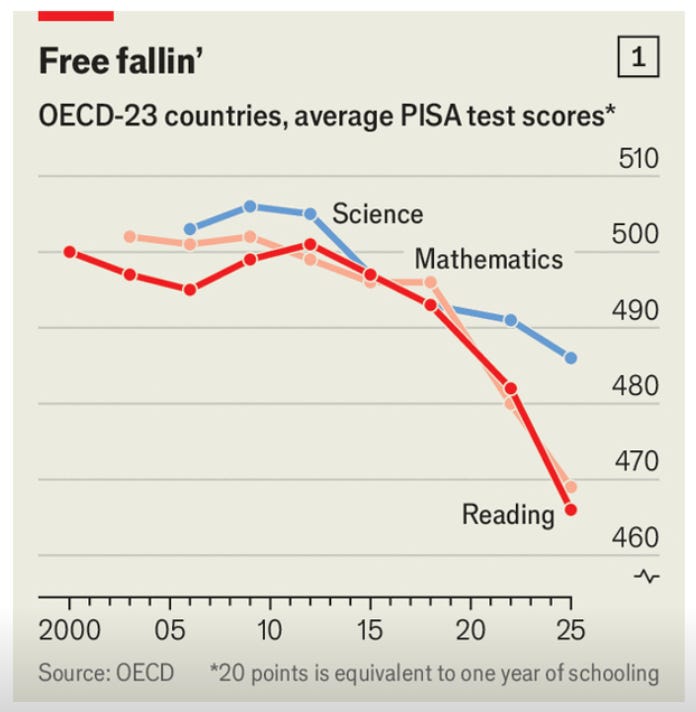
As noted above, the other big education news this week was the release of the 2025 PISA results. Average performance across OECD countries has fallen to the lowest level PISA has ever recorded in reading, math, and science—with reading and math especially continuing a free fall that began just after 2010 (which also happens to be when social media shifted onto smart phones). The figure below, from the Economist, illustrates the deeply troubling trend.
I’ve already mentioned Andreas’s argument that AI may contribute to cratering test scores around the globe, but let’s check in with additional analysts for other takes.
One of the big story lines is about England, which was already an ed-reform darling among the knowledge-is-power crowd (myself among them) before Tuesday’s PISA release showed it leaping up the league tables. As Daisy Christodoulou wrote on X:
The best evidence that the fads might be causing this problem is that one of the few countries to escape the general fall in scores is England—also one of the few countries to explicitly reject the fads and take a different approach.
Contrast with Scotland—a similar country which had basically the same PISA scores as England in 2012.
Since then the two countries took very different educational approaches and Scottish students are now about a year behind English ones in math and science (and behind by a smaller amount in reading).
Fellow Brit Carl Hendrick agrees:
For those of us in England, it’s pretty clear now that the Nick Gibb–led reforms based on systematic phonics, a knowledge rich curriculum, and explicit instruction have yielded strong results in reading. England are one of the few developed countries not to show a decline and the contrast with neighbouring Wales and Scotland strengthens that case.
We move now to today’s latest upset: the PISA 2025 results, which indicate that England appears to be smashing it in all three categories, roaring into the top ten everywhere, and beating almost every other country outside of Asia. This appears, on the surface, to be a monumental endorsement of the direction of travel over the past decade, with its slow, continuous emphasis on direct instruction, knowledge-rich, carefully sequenced curriculums, behavior management, and externally-assessed terminal exams.
Of course, critics don’t see it this way. This data painfully contradicts everything they believe. So how do they explain away something that undermines the foundations of their certainties? “PISA doesn’t matter anyway.”
We’ve heard this tune before, many times. These are the people who would probably contest the success of modern versus folk medicines and faith healing. “What even is getting better anyway? This is just a narrow definition of being well,” they would say, wheezing into their muslin pouch of belladonna and ginseng root before they keel over.
Because PISA very much mattered when people were feting Finland in 2000, as that country rode the lightning of success (despite the fact that its success was not in fact down to the progressive woo going on at the time, but the decades of good practices that had been used before that… which had been ditched right before the PISA outcomes). Back then, PISA was proof positive that Finland, with its project work and its discovery learning, was a shining example for others to emulate. But no one is visiting Finland anymore to find out how they do it, because of years of decline.
Chad Aldeman noticed Finland’s decline, too:
In science, Finland’s scores have fallen 59 points since 2006.
In reading, Finnish students are down 73 points.
And in math, Finnish students are down 79 points since 2006.
Chad continues:
So what explains Finland’s rise and fall? I’m partial to a long 2015 deep dive called “Real Finnish Lessons“ by the Centre for Policy Studies, a center-right think tank in the U.K. It argues that Finland’s academic rise predated many of the features later hailed by American progressives. Throughout the 1980s and into the 1990s, when Finnish students were making their big gains, schooling was quite centralized and prescriptive, and classroom instruction was traditional and teacher-led. People were going to Finland after it became successful to study what its schools looked like at the time, rather than asking what Finnish schools looked like as the gains were occurring.
So that’s the story overseas: Fads fade, fundamentals are important, and places that held the line are worth studying. But let’s not bury the lede: America’s reading woes continue.
Cue National Review’s Rich Lowry for some self-flagellation. After wringing his hands about screens in schools, Rich writes:
The larger problem…is what’s happening outside the classroom. Education expert Frederick Hess of the American Enterprise Institute notes a study from Common Sense Media that found that eight- to twelve-year-olds are on screens for more than five hours a day, and 13- to 18-year-olds more than 8.5 hours.
That’s a tide that’s hard to overcome. The new technology may pack a one-two punch: On the one hand, screens and social media make people dumber by diminishing our attention span, while, on the other, AI makes it easier to be stupid by doing our thinking for us.
Kevin Huffman, on the other hand, offers a pragmatic take:
Instead of the biennial self-flagellation, I would suggest that we understand that our national results mask significant state-by-state variation. MS, LA, TN, and D.C. all saw steady gains vis-a-vis their peers as they embraced stronger curriculum, and the use of data to drive both support and accountability. Other states took their foot off the gas with predictable results. Given that the federal government has neither the inclination nor the capacity to build out a strategy, we have to embrace the state-by-state nature of the work.
There are 36 governors’ races this year. When I see Republicans centering their education policy around expanding vouchers, which, at best, serve fewer than 10 percent of kids, or I see Democrats only offering to “fully fund” schools or reduce testing in an era of tightening state budgets and declining outcomes, I am genuinely outraged.
If we have a national crisis—and we do—and we don’t have a national solution—and we do not—then we have to lean in and push states on the things that the vast majority of parents want: a focus on better reading, math, and science materials and instruction, tutoring for kids who are behind, access to strong work-based opportunities in high school, and an end to culture-war posturing.
I appreciate Kevin’s bipartisan haranguing, but the blue states really do seem to have a bigger challenge when it comes to turning around the reading recession. That’s the takeaway from a smart analysis by Rachel Canter in the Wall Street Journal, merging ExcelinEd’s data on state reading policies with the Fordham Institute’s data on teacher union strength, finding a “strong, negative correlation between the two—the more powerful the unions, the fewer literacy policy principles the state had adopted.”
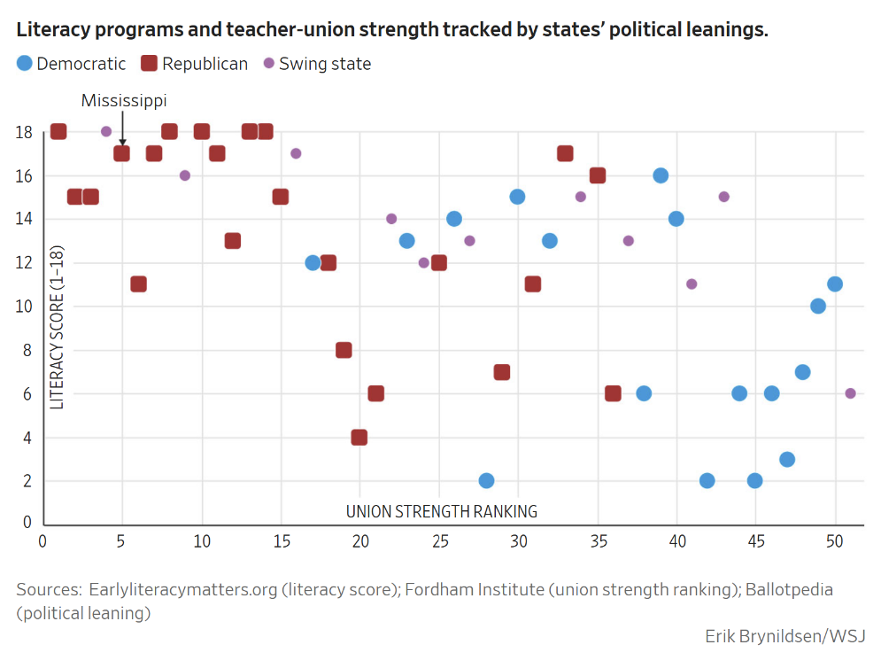
Still, as Rachel notes, it’s not a perfect correlation. Some red states are lagging, “and sometimes, the unions can be won over—or beat.”
Consider recent victories in New Mexico, Maryland, and Massachusetts, where advocates built the political will to adopt reforms despite pushback from their unions.
The takeaway, writes Rachel, is that:
While political headwinds remain a hindrance to education reform, these recent legislative developments show that policies supporting evidence-based literacy can gain traction across diverse constituencies.
The question is whether policymakers, regardless of party alignment, have the courage to risk taking heat on behalf of our children’s future.
Amen!

Other edu-opinions worth your attention
Daniel Buck, “Three Policy Avenues to Help Public Schools Flourish”
Meredith Coffey, “What Massachusetts’s portrait of a learner gets right (and New York’s doesn’t)”
Ray Domanico, “Traditional Schools Are Losing Their Grip on K–12 Education”
Ingrid Jacques, “Will Democrats delay Trump’s school choice tax credit?”
Bruno V. Manno, “Without Part-Time Jobs or School Clubs, Teens Miss Out on Basic Life Skills”
Michael McShane, “Enrollment Down, Funding Up”
Morgan Scott Polikoff and Rachel Anderson, “How State Board Leaders Can Build Next-Generation Accountability”
Jed Wallace, “Of Alphas and Betas and Getting the Charter School Recipe Right”

Ben Sasse extols the virtues of football as “a character-forming institution that channels strength” during a time when boys struggle with factory-model schooling and the temptations and distractions of the digital world.
In a world of instant gratification, it teaches perseverance through early practices and aching muscles. In an era of isolation, football creates community. It forms brotherhood through both misery and joy. In a culture of passivity, football privileges action. In times of peace, football prepares us for war.

“While national test scores have largely stagnated or declined in key subjects like math and reading, graduation rates continue to creep up nationally,” writes Lily Altavena. “The use of credit recovery to help students graduate could be playing a role.” Lily digs into the data and talks to Johns Hopkins’s Samantha Viano, who says schools and districts are often “very blasé about their credit recovery enrollment,” and may “not really understand who’s in those classes, what they’re doing in those classes, how long it takes them to work on them.”

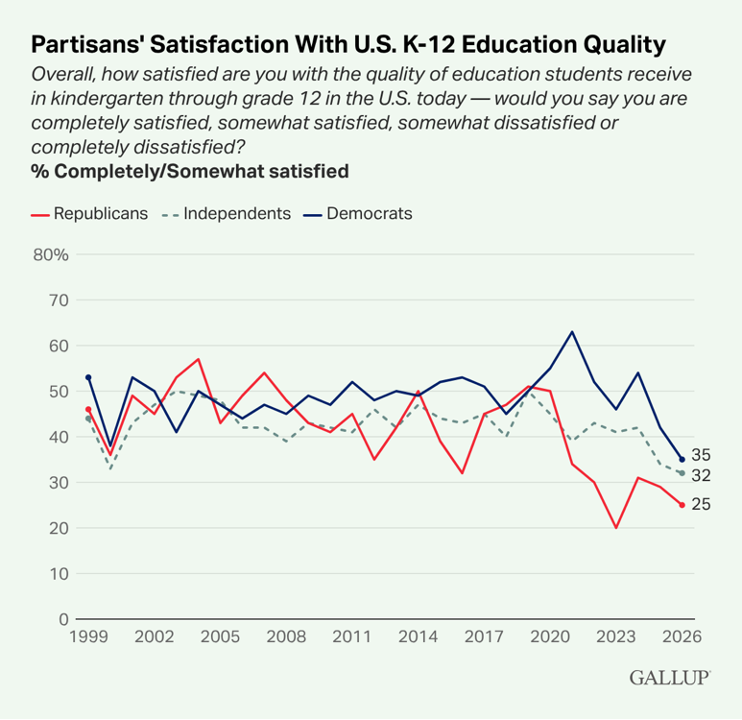
Also on the decline? The public’s satisfaction with American schools. Jocelyn Gecker shares Gallup’s new polling results, which show a sharp rise in dissatisfaction among U.S. adults. Once again, parents tend to think more highly of their own kids’ schools than the system as a whole:
About two-thirds of parents with school-age children say they are satisfied with their child’s education, which is also a low point in the trend—parents haven’t had a similarly discontented view since 2013—but double the 32 percent satisfaction with U.S. education among adults overall.
Gallup’s Megan Brenan has the full details, including a chart showing how those on the left and right are coming toward consensus…on how dissatisfied they are with the quality of the nation’s schools.

Paolo DeMaria writes in about our college-for-all debate from a few weeks back:
I’ve wanted to weigh in on this debate for a while now, and the nice compilation of commentary from August 21 gives me a good opportunity. I think my addition to the debate is to encourage us to move our thinking away from the concept of “on average.” I love the book The End of Average because it emphatically makes the case that no one is the “average.” The average is a mythical representation of a lot of individuals. If we know that some students go to college who don’t succeed and maybe shouldn’t have gone, and some go into non-college career programs and options who could be better off with a college degree, wouldn’t it make sense that, rather than arguing where the emphasis should be—and where success is likely to be achieved “on average”—that we focus on how we can do a better job to help each student—as an individual—understand how to identify and engage in the system and land on the path on which they will most likely succeed—with more nuance and more customized precision? Yes…this is a tougher challenge than the “emphasize college” versus “emphasize CTE” duality—but it’s the right challenge to take on because in the end it reduces the amount of waste in the system. Every time any student ends up where they don’t succeed is a waste of the system’s (and the student’s and family’s) time, effort and resources. I agree with Laura Slover that we need multiple pathways, and they all need to be valued. But we should do a better job helping students (and their parents) discern the likelihood of success. Yes…we need to develop students’ knowledge, skills and experiences—but in the end, and consistent with The End of Average, every student will have a different mix of these attributes—and their particular mix may serve them better in a particular setting or a particular path. I’m all for rigor in all its manifestations, but a cookie-cutter approach to what students should be doing in high school hasn’t made sense in the past, and it won’t in the future. The Maryland Blueprint is a good model, but even greater variation of learning approaches could be even better, without compromising on ensuring rigor and mastery of knowledge needed to be successful.
I also think many of those weighing in on this question let higher ed off the hook too easily. Vlad Kogan doesn’t go far enough with his comments, which focus on criticizing for-profit programs and community colleges. There are plenty of four-year institutions—including some of the more selective ones—that also do a dismal job of getting students to a degree—and could do a whole lot better. Yet another example of system waste. In spite of what we know that can help more students complete, many institutions seem content with completion rates of less than 50 percent. (And they then complain about declining enrollment! If they moved their completionrates to higher levels, the enrollment decline would be lessened.) If an institution doesn’t have a deliberate college completion strategy, and the data to show that it’s working, they aren’t doing their job.
See you next week.
Mike
Sign up to receive this newsletter in your inbox, usually on Friday mornings. SCHOOLED is free, but a few linked articles may be paywalled by other publications.
AI moratoriums are a necessary step for all educational institutions for one very simple reason: we must first do no harm.
Looking back at the last 20 years at the unimaginable amounts of damage that social media and smartphones have wrought, especially to children, and the complete and utter failure of “ed tech” on educational outcomes as a whole, to take any other position is unconscionably naive, or betrays a serious conflict of interest.
We also have to contend with the fact that it doesn’t matter whether school districts approve this or that product. Kids have access to all of it. I can STILL play Five Nights on Epstein’s Island with my fourth-grader’s school account. As of last week I found a link easily on the first page of a search that worked. This is after reporting multiple links to the school district for the game and the district spending millions with companies like Lightspeed and iBoss to filter and block. It doesn’t work.
Google’s AI Overview, rated an “unacceptable risk to children” by the tech-friendly Common Sense Media, is easily accessible and can’t be turned off, and you can be sure kids are using it to do their schoolwork at scale. A Baltimore dad I know has reams of data showing his son used it to do all his math assignments over a period of months, in between searching for entertainment and - of course - porn on his school device.
What we doing here? What is the purpose of education? How is it best served? I know what works - teacher to student connection, writing and reading by hand, mental struggle, the joy of mastering something after working through what feels like tedious labor, the messiness of peer interaction in person, a story about the purpose of education that makes sense, that resonates, that is not just about career readiness.
There is no place for AI in that. AI will have to earn its way in, and it has a high bar to clear and a sordid history to overcome.
Betsy Tao
MCCPTA Technology Chair
P.S. The new Fordham Institute survey report is outstanding!
I’m a classroom teacher who follows you just so I can think intelligently about big picture policy, though I very clearly have little power over making it. My perspective on the AI question is the same as with all tech questions— humans do best with human connection, so the more of that I keep in my classroom the better. I’ve stayed pretty low tech and I would argue that’s been pretty successful. Lastly, as I think every time you mention “high quality curriculum,” I wonder what that actually looks like in a high school social studies classroom? Thank you for all your hard work and dedication to challenging readers in exactly the way I’d hope I’m challenging my students!