Hi, friends. I hope all the moms out there enjoyed a wonderful Mother’s Day. My wife chose a family trip to Costco for her special day. (Don’t knock it till you try it!)
Today we tee up a debate about blue states opting into President Trump’s Education Freedom Tax Credit, with views from John Ketcham and Peter Greene; hear from Emily Oster and Jonathan Haidt on the big phone-ban study; get a history lesson on state education policy from Mike Kirst; dig into strategic staffing with John Luczak, Allison Pennington, Sarah Begeman, Sharon Kebschull Barrett, and Bryan Hassel; and round up other recent takes from Chad Aldeman, Rick Hess, and Charlie Barone.
Getty Images / AlizadaStudios
Last week, New York Governor Kathy Hochulmade big news by announcing her intention to opt her state into the federal Education Freedom Tax Credit (EFTC)—though her office later hedged a bit. Chalkbeat’s Erica Meltzer and Alex Zimmerman explained:
Emma Wallner, a spokesperson for the governor, confirmed Hochul’s plans to opt in to the tax credit.
“Governor Hochul is supportive of the federal tax credit scholarship and its potential to help New York students and schools,” Wallner wrote in a statement. “Our office awaits information from the federal government on the program and will thoroughly review the details of the policy for poison pills that could harm New York’s education system.”
They will have to wait another few months for said “information”—i.e., the Treasury Department regulations that will govern the initiative—if current rumors about Treasury’s timing are correct. And most likely, those rules won’t say much, except that governors like Hochul will have little say over which Scholarship Granting Organizations can work in their states, as long as they meet the minimum requirements of the law.
That would, indeed, be a poison pill for those who are dead set against private school choice, including funding for religious schools. Peter Greene, for example, went on a rampage against Colorado Governor Jared Polis over the weekend for opting into the tax credit initiative—the only Democrat besides Hochul to do so to date—even though it could support schools that discriminate against gay kids. (Polis is openly gay.)
The federal voucher program is simply federally-funded discrimination, a chance for the government to transfer its tax liability to private schools without holding them to any sort of anti-discrimination standards. It’s the government spending what were supposed to be tax dollars on activities that only benefit a selected few.
But what about those of us who support school choice in all its varieties but aren’t crazy about the particulars of the EFTC? Who view private school choice, including for faith-based schools, not as “discrimination” but as support for educational pluralism? Should we celebrate the decisions by Hochul and Polis?
Regular readers of SCHOOLED know that I’ve been defending Democratic governors who want to wait for the Treasury regs before they opt in. That only seems fair, and reflects my hope that perhaps the Trump administration will yet decide to give governors some leeway in how the initiative works in their states. For example, if a blue-state governor wanted to limit eligibility to poor and working-class families, or require some testing and transparency provisions, Washington might go ahead and let them.
But those are my policy preferences. As the Rolling Stones taught us, you can’t always get what you want. So what if the option is a clear binary choice:
States opt in and agree to approve every qualified Scholarship Granting Organization, even those that plan to provide scholarships to upper-middle-class families and/or those that don’t require any testing or transparency from participating schools; or
States don’t opt in, and their students and families—in both the public and private school sector—can’t benefit from taxpayer donations funded by the tax credit.
If that’s the choice, I say: Opt-in. Blue states included.
The New York opportunity is particularly exciting. The Empire State has long been home to among the largest Catholic school sectors in the country, with a proud history of serving poor and working-class families well and providing their students a boost to upward mobility. Yet given the state’s deep-blue politics, no private school choice program has ever been in the cards. Now, thanks to Governor Hochul’s brave decision, we can imagine that thousands of low-income and working-class families could gain access to high-quality urban Catholic schools.
Many such schools have already closed their doors under the weight of insurmountable fiscal pressures. Seven Catholic schools in Brooklyn and Queens will close in June, followed in July by three more closures in the Archdiocese of New York. The city’s skyrocketing cost of living has made it harder both for parents to afford tuition and for teachers to accept parochial-school pay.
I know these struggles firsthand from my volunteer service as treasurer of Astoria’s St. Francis of Assisi Catholic Academy, the grammar school I attended as a child. Running a private school in New York City on tuition of just $7,300 per pupil is a grueling exercise in scarcity. Each new school year brings stark tradeoffs between fundraising, family affordability, teacher compensation, building maintenance, classroom materials, and basic operational needs.
The SGO tax credit will give schools like mine a chance to relieve chronic fiscal strain and focus more fully on delivering the highest-quality education. It will also help parochial schools boost teacher pay, in turn improving the retention of talented teachers and giving these educators more of the income necessary to live in New York.
And Catholic dioceses are probably the entities best positioned to turn the EFTC into life-changing scholarships. That’s because church leaders can petition their affluent parishioners to take the tax credit, donate to a Scholarship Granting Organization affiliated with the church, and then turn those donations into scholarships for poor and working-class students. There aren’t many other organizations in America that serve both rich and poor and can play matchmaker at scale between donors and recipients.
And for me, keeping Catholic schools open, thriving, and full of low-income and working-class families would be an outcome worth celebrating, even if the initiative doesn’t include the policy designs I prefer. (I do hope they choose not to exclude gay kids or the children of gay parents, though they have a First Amendment right to do so.) And that’s without contemplating the potential benefits to public school and charter school students.
What do you think? Especially for those of you open to private school choice, but not sold on the details of the EFTC, do you agree that Hochul’s move is worth celebrating nonetheless? Please weigh in by responding to this newsletter, leaving a comment below, or emailing me at SCHOOLED@fordhaminstitute.org.
The other big news last week was the study on phone bans by an all-star team including Hunt Allcott, Tom Dee, Angela Duckworth, and Brian Jacob. Emily Oster’s take was spot on—in essence, that we expected too much from these bans. About that paper, she writes:
Phone bans had a very minimal impact on student behavior and academics in a nationwide sample of schools. Phone usage went down, and teachers liked the policy (all good), but test scores didn’t change much, disciplinary infractions increased in the short term and there was no demonstrable effect on bullying or student attention. Basically, not much changed.
This finding should not have been as surprising as it was. Based on what we know about phones and education, it is not realistic to expect phone bans to have enormous impacts on academic outcomes. But that doesn’t mean that they are a bad idea, or that they should be walked back. Instead, we need to approach this topic with more realistic expectations, a richer approach to what counts as a positive outcome and more help for families and schools.
The expectations for phone bans were poorly calibrated, largely because the data on which some of the more extreme claims about phones is based is subject to considerable biases.
Some of those claims came from Jonathan Haidt, probably the world’s foremost proponent of phone bans. To his credit, Jon demonstrated how to play defense without getting defensive by being measured in his response to the study.
The damage from distraction and fragmented attention has been compounding for years, and it may take years to turn it around—especially if newly phone-free students can just turn to their school-issued Chromebooks and iPads for distraction during class. So a lot more work needs to be done to improve the climate for cognitive development in schools and to measure more variables about classroom ecology.
In the meantime, phone-free schools seem to be producing more social interaction in class, and a lot more noise and laughter in the hallways, and at lunch. Teachers like their jobs more, and some schools report big increases in library books taken out. All of these social benefits seem to kick in in the first few months. I hope other researchers will study these widely reported social and behavioral effects more systematically.
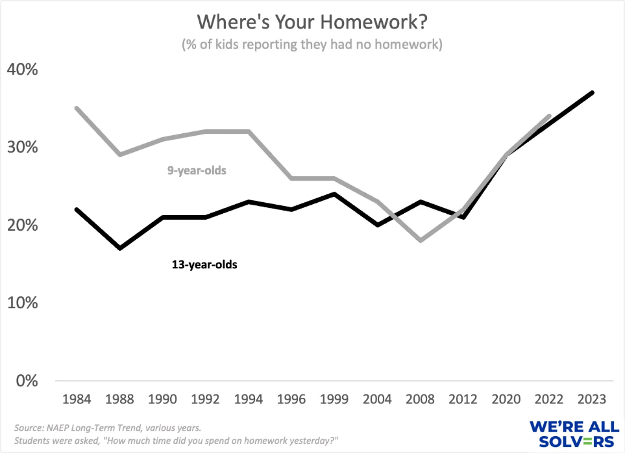
If “distraction and fragmented attention” is a problem in the classroom, it’s nothing compared to what today’s kids face when they are at home and supposed to be studying.Though Chad Aldeman doesn’t think screens are to blame for the rise and fall of homework.
The percentage of 9-year-olds reporting they had no homework has followed a U-shaped trajectory. In 1984, 35 percent of students at that age reported having no homework, but those numbers had fallen in half by 2008. That year, 82 percent of 9-year-olds reported having some homework, with the vast majority reporting less than one hour of work.
As math expert Tom Loveless has noted, the trends started to reverse in 2008. Since then, the percentage of 9-year-olds saying they had no homework surged from 18 to 34 percent. The percentage reporting they had more than two hours declined by 1 point (5 to 4 percent), the percentage with 1–2 hours declined 3 points (12 to 9 percent), and those with less than an hour of work declined 14 points (60 to 46 percent). We also hit a new high in terms of kids who said they had homework but didn’t do it (7 percent, up from 5).
If not screens, what is to blame? Chad acknowledges that we can’t know for sure, but posits that:
States and school districts have cut back on accountability in a number of ways, from weakening graduation standards and easing back on school and district accountability requirements to limiting in-school suspensions and expulsions. Some advocates have argued that homework is inequitable because not all kids have the same at-home supports or responsibilities.
When homework started to decline, NAEP scores soon followed. And this was long before TikTok and AI, making these challenges all the greater.
Homework might not be back but bipartisan ed reform is. So says none other than professional skeptic Rick Hess!
For better and worse, old-fashioned school reform shows signs of making a comeback. Fueled by dismal academic results, troubling levels of absenteeism and classroom misconduct, concerns about the doomscrolling mind virus, and a general sense of post-pandemic reckoning, one can see hints of revival everywhere. The science of reading has grown from a brushfire into a four-alarm movement. Proposals like state takeovers of failing schools are back on the radar. Advocates are pushing hard for civics, “high-quality” instructional materials, career pathways, and new high school models. Democrats for Education Reform has got its mojo back. School choice has exploded. There’s steady chatter about the prospects of resurrecting bipartisan school reform.
Rick offers five lessons for us reformers, especially those new to the movement since its decade-long hiatus:
Don’t mistake initial wins for lasting victories.
Resist drinking the Kool-Aid.
Listen with a purpose.
Money is a mixed blessing.
Recognize that six-sevenths of the iceberg is out of sight.
Charlie Barone is also offering lessons for reformers—of both political parties. After taking readers through a tour of recent polls of parents and voters, demonstrating that there’s more agreement than division, he offers this pearl of wisdom:
What does polling tell us people want? Something neither party has fully earned: trust. The party that treats education as a culture-war signaling device will keep mobilizing its base while losing most voters’ confidence. Ideological agendas, partisan fads, and “silver bullet” policy slogans will not ultimately deliver what most voters and parents want from their education system. And, sooner or later, those chickens will come home to roost. The party that treats parents as partners and schools as practical institutions with civic purpose will have the advantage. Polling rewards listening. And if leaders listened more carefully, they would hear a remarkably consistent request from parents: stop turning schools into symbols and start ensuring they deliver what parents, voters, and taxpayers are clearly asking for.
Finally, the new edition of the State Education Standard reimagines the roles of teachers and leaders and is full of worthy contributions. Among them: John Luczak, Allison Pennington, and Sarah Begemantake us inside strategic staffing models made famous by Arizona State and Opportunity Culture.
Moving away from “one teacher, one classroom” requires foundational shifts in a school’s culture and structures. For example, traditional staffing models center the principal as the sole instructional leader for the school; strategic staffing calls for a culture that values and develops instructional leadership in many forms and corresponding structural changes to create new leadership roles and compensate them. Under traditional staffing, a single teacher of record holds responsibility for the academic growth of a class of students; strategic staffing fosters a culture in which multiple adults share responsibility for student growth, supported by structures like updated teacher evaluation processes and student information systems. Changes this significant cannot happen without strong buy-in from school and district leaders, flexible policies, and access to high-quality technical assistance.
A key facet of our Opportunity Culture staffing design work has been tapping teachers with a record of high student learning growth to become team leaders and paying them more. Doing so has more than doubled the number of teachers producing high-growth student learning in places we have worked. Students gained two to thirteen extra months of learning growth in math and reading. Even same-school students in classrooms not part of these teaching teams increased their learning growth.
I’m glad to hear that because one of my main concerns about “strategic staffing” is that it equates to “more staffing”—which has been the norm for American education for at least fifty years, at the expense of higher teacher salaries. If instead this is a strategy to boost teacher pay, count me as intrigued.
“Seventeen- and 18-year-olds are expected to navigate an astoundingly complex labor market, often with little or no explicit guidance,” writesLauren Weber, a problem compounded across rural America, “by a dearth of opportunities and professional role models.” She looks into rootEd Alliance, started by investment banker Byron Trott, that places college and career advisers in schools:
Advisers are agnostic on whether students choose college, military service, employment or trade school. The goal is for each senior to have a Plan A and ideally a Plan B. To get there, advisers organize visits to employers, pile students into vans for college tours and keep lists of local scholarships.
Most important, they say, they push students to think about the future.
Talia Richman reports on how some Maryland schools lower expectations for students with cognitive disabilities, setting children as young as kindergarteners on a pathway unlikely to lead to a high school diploma. In better news, the state department of education is pushing back, proposing guardrails to curb districts that have been overusing alternate assessments—which lead to a completion certificate rather than a diploma. —The Baltimore Banner
“Welcome to the life of a beta mother,” writes Rachel Wolfe. “After decades where the dominant expectation for high-achieving parents was to intensively helicopter, a new generation of moms is saying ‘enough.’” —The Wall Street Journal
I taught state politics of education at Stanford and was on the California State Board of Education for 15 years. The variation among states is vast and embedded deeply in their historical political culture and structural approach to how they handle state versus local control. There is a subfield in political science called comparative state politics that documents this. States develop deeply embedded assumptive viewpoints about the appropriate state versus local roles. The need now is not one size fits all, but how to tailor better curriculum and instruction implementation to specific state contexts.
The southern states developed public education later than the north, and after the Civil War. They lacked the property tax base to rely on small districts, so they formed county and city school districts. At the turn of the 20th century, California had 3,500 districts and Nebraska had 7,000. Florida stopped at 67 counties. Maryland, Virginia, and North Carolina have county school boards and a few cities. The state role in the South is more centralized than in other regions. For example, many Southern states had statewide salary schedules. This history enables many Southern states to be more aggressive and directive in mandating and enforcing state policies.
The predominant challenge now is how to adapt what works in the South to states that have many districts and a history of local control. This will be difficult because each state requires a different prescription. It will be a state-by-state process that will vary even among the states with collective bargaining that includes several different employee unions composed of teachers and noncertified employees. California will be interesting to watch because it passed a literacy bill in 2025 that required negotiations among many interest groups in a state so large that local control is part of its assumptive world of state policy. The California Department of Education is not as well staffed in curriculum and instruction on a per capita basis as most of the South. It must rely more on regional County Offices elected locally to impact classroom teaching.
See you on Friday—or at Costco!
-Mike
Sign up to receive this newsletter in your inbox, usually on Tuesday and Friday mornings. SCHOOLED is free, but a few linked articles may be paywalled by other publications.