

No more lines?
Our debate on neighborhood schools and school boundaries continues.

Happy Friday, friends. It’s certainly happy for me (and not just because I’m about to depart on a trip to Sicily with my family). I’m thrilled with the enormous amount of engagement that Tuesday’s post inspired. My defense of school boundaries and neighborhood schools clearly struck a nerve. I’ll share responses today and again next week, starting with those from Tim DeRoche, Charlie Barone, Jude Schwalbach, Patrick Wolf, and Eric Premack.
Also in today’s edition: Don Hirsch and Dan Willingham on knowledge-building’s time in the sun; Paul DiPerna on the political parties’ popularity on K–12 education; Charlie Barone on Democrats in the ed-reform wilderness; the Wall Street Journal on Andy Beshear’s opposition to school choice; Molly Macek on Gretchen Whitmer’s error on grade retention; Elliot Haspel on pre-K and the Southern Surge; and the two Ricks on civics.
Sign up to receive this newsletter in your inbox, usually on Tuesday and Friday mornings. SCHOOLED is free, but a few linked articles may be paywalled by other publications.

On Tuesday, I expressed skepticism about eliminating school and district boundaries, which would, I argued, kill the neighborhood public school as we know it. Let’s start the pushback-palooza with Tim DeRoche, whose report on educational redlining in New York inspired this whole debate:
Thanks for drawing attention to our report, Mike, but I think you’ve mischaracterized our position. No one wants to “kill neighborhood schools.” We all shop at the neighborhood grocery store. We send our kids to the childcare center down the street. We utilize the local post office. We do all of the above without empowering the government to draw maps that keep our neighbors out.
Our proposed solutions are explicitly designed to preserve the neighborhood character of public schools. Requiring a school to reserve 15 percent of its seats for kids outside of the zone is hardly a recipe for chaos. And redrawing attendance zone boundaries—that’s something that districts do all the time. (You’re certainly right that it can be politically difficult for the most coveted public schools, as the homeowners feel that they have “already paid for” access to the school via their mortgage. Of course, these schools are billed as “free” and “open to all.”)
Also, you don’t mention another one of our proposed solutions: creating student-based zones. With this simple change, every child would be guaranteed an equal opportunity to enroll at any public school within three miles of his or her home. That’s an argument for access to neighborhood schools, not against it.
As for open enrollment (OE), it’s a lot less scary than you make it out to be. That’s because all the OE policies that I’m aware contain a “capacity exception,” which allows a school to turn away non-zoned students if the school is “full.” Sixteen states have universal, non-discretionary cross-district OE, according to Reason’s last report, and every single one of those states still has robust neighborhood public schools. (Alas, this exception gives schools the opportunity to play games with the definition of “full.” We showed last year that high-performing elementary schools in the Los Angeles Unified School District typically don’t report their empty seats as available to non-zoned students, despite the fact that it’s required by law. That’s one reason we argue that simple OE is not enough.)
Similarly, decriminalizing address sharing, which Connecticut did in 2013, only means that parents can’t be put in jail for using someone else’s address, a common practice that is often selectively enforced against low-income people of color. Decriminalization doesn’t end residential assignment, and, unfortunately, does nothing about the exclusionary maps. It’s still a good first step.
The hard truth is this: There are really a very small number of high-performing public schools that are in demand. That means we need some method of determining who is allowed to attend those schools—and who isn’t allowed in. Currently, we have a strict, top-down system based on address, which creates huge distortions in housing prices and turns them into quasi-private schools for those who can afford the pricey homes within the zone.
That’s fundamentally at odds with the sacred mission of the public schools.
As I wrote the other day, I didn’t see anything in Tim’s report calling to maintain attendance zones in a system of open enrollment. I’m glad for him to clarify his position. Speaking of open enrollment, let’s hear next from the leading advocate for (and analyst of) open enrollment policies nationwide, Jude Schwalbach:
The current system of residential assignment carries a lot of baggage. It also forces families into boxes where their largest investments (i.e., homes) are intrinsically tied to a single public school. This structure lacks the flexibility that should be afforded to students and their parents, especially as K–12 education is a deeply personal experience. Students aren’t just taught the three Rs at school, education shapes student’s views and introduces them to new ideas. This requires significant trust between families and schools. If it fractures, then students should be able to pursue their education at other public schools. More pragmatically, it can block students from learning options not available in their assigned district or trap them in schools where they feel bullied, unsafe, or alone. No one wants this for children.
Ideally, if we were starting from scratch, we wouldn’t design a school assignment system based exclusively on residential assignment. This is where the vision of a boundaryless education system arises. But the tie between home ownership and public K–12 education isn’t going anywhere in the short term. Pragmatically, well-designed open enrollment programs can weaken the rigid barriers imposed by residential assignment. These policies let students transfer to public schools with extra seats available, which means that resident students are never displaced from their assigned schools by transfer students. This is the case in all of the 16 states with universal open enrollment laws on the books.
The bones of a good open enrollment law
Reason Foundation’s seven open enrollment best practices create a model open enrollment policy. Together, these provisions seek to balance true local control (families’ decisions about the public school that’s best for their kids) with the communal local control often associated with public schools.
Under a strong open enrollment law, districts with available capacity must admit transfer applicants, ideally through a randomized lottery. These capacity limitations, often set by districts themselves, wouldn’t require districts to admit students if it would require them to build new facilities, hire new staff, etc.
Robust open enrollment laws also ensure that districts can’t stop students from transferring to other public schools. Weak policies in California, New Hampshire, and Mississippi let districts cap the number of students transferring out of their districts (if districts can’t stop students from leaving to go to private schools, the same logic should be applied to cross-district transfers).
What does this mean for neighborhood schools?
In many states with robust open enrollment laws, public schools remain a cornerstone of a community. The latest Gallup polling shows that many families are still satisfied with their public schools, suggesting that most students would remain in their current schools. Plus, open enrollment data show that these programs tend to scale up gradually, giving districts plenty of time to respond to fluctuating enrollments.
For example, data from Wisconsin’s program show that it scaled up incrementally, growing from 2,400 (0.29 percent of public school students) to 62,000 participants (8 percent of public school students) over the course of 27 years. Similar data from West Virginia and Kansas indicate similar trends, where just 0.6 percent and 0.3 percent of students transferred to public schools in other districts during the programs’ first year of operation.
This means, contrary to many district administrators’ fears, that robust open enrollment laws don’t lead to chaos. In fact, we have good data from multiple states showing that districts can successfully operate even when student mobility is high. For example, 103,000 Arizona students (13 percent of students enrolled in the state’s traditional public schools) transferred to districts other than their assigned ones. On average, data from the 14 states with strong cross-district open enrollment laws show that 6 percent of these states’ public school students use these programs.
In sum, open enrollment is a step toward a boundaryless education system, giving students more flexible education options when extra seats are available. This increases public school accountability as families can vote with their feet and helps many students attend schools that are a better fit regardless of where they live.
Well said, Jude. Next up is Patrick Wolf, with a pithier take (taken from X):
School boundaries are unnecessary and evil anachronisms. No more lines!
OK then! But Charlie Barone “complicates the narrative,” as they say:
I agree with Derrell, Adam, and Tim as to what the ideal policy is. Current school boundaries limit educational opportunity. Although I also acknowledge the politics and community dynamics that Mike points out. D.C. seems like a decent model for balance.
What I find striking, though, is how many of those who advocate for eliminating redlining simultaneously support public subsidies to private schools, through vouchers and ESA’s, where those schools can discriminate based on not just geography but a whole range of class-dividing criteria.
Zing!
Finally, here’s Eric Premack with an idea that might be more radical than killing off neighborhood public schools:
Hi, Michael. Saw your piece this morning about policies to require all public schools to have at least some of their seats set-aside for non-resident students.
I’ve long advocated for a supply-side version of the same: Allow school districts to operate schools anywhere within their state or within their region of the state. My sense is that doing so would force many weaker public schools to close or consolidate and would allow more well-managed districts to expand. Such policies would raise a number of implementation and other issues, but none that we haven’t encountered in the charter sector.
Stay tuned for more on Tuesday.

Let’s start our regular roundup of recent edu-opinion with Paul DiPerna, offering his take on how parents and the public view the two political parties on K–12 education. After a useful summary of other recent analyses of the topic, including those from Nat Malkus, Matt Barnum, Caitlin Peartree, and David Winston, he offers fresh data from EdChoice’s own poll. In a nutshell, in Paul’s words:
Trust in both parties is very low.
Democrats maintain modest advantages.
Parents of school-age children view the two parties roughly the same, whereas adults without school-age children are much more likely to favor Democrats.
Also check out this fun post by Paul’s colleague, Mike McShane, about Paul Peterson’s “coaching tree.” What an impact!
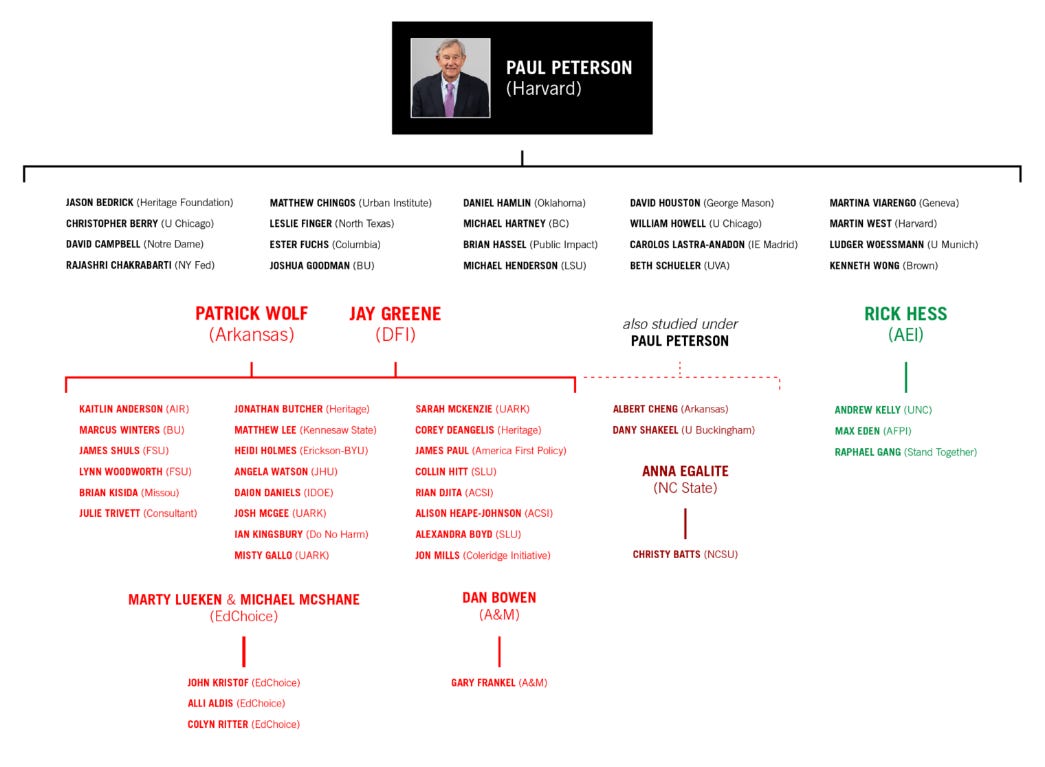
Paul DiPerna’s polling analysis is a great setup for Charlie Barone, who takes to Education Next to explain how Democrats “lost the plot” on schools and “can get it back.” He’s glad to see some politicians and pundits acknowledge (including here at SCHOOLED) that Team Blue has a problem. Now it’s time to fix it, and Charlie offers a five-point plan:
Strike a grand bargain. Democrats must come to an understanding with teachers unions and white progressives that unconditional opposition to innovation, accountability, and public school choice is a political and moral dead end…
Broaden the labor coalition. Teachers unions don’t represent everyone in labor affected by education failure. Far from it. SEIU and other unions represent parents and students, too…
Align with parents. Democrats have spent years talking around parents instead of to them—and sometimes worse, treating them as a problem to be managed rather than partners to be respected…
Elevate rank-and-file teachers. Groups like Educators for Excellence and Teach Plus show that classroom teachers are often far more reform-minded than union leadership.... Their efforts need support, and their voices need amplification…
Professionalize teaching—for real. Every high-status profession eventually modernizes training, compensation, and expectations. That hasn’t happened in teaching. I believe it will—and Democrats should lead that transformation, not resist it.
(Also worth reading: Charlie’s take on the need to reform FERPA. If you know, you know.)
One Democrat that doesn’t seem to be listening to the Charlie Barone’s of the world is Andy Beshear. The Wall Street Journal editorial board takes him to task for vetoing a bill opting Kentucky into the Education Freedom Tax Credit:
He calls it an “end-around” the state constitution “which requires public funds go to public schools.” He cites the defeat of a state ballot referendum in 2024, which would have amended the state constitution to clarify that the Legislature could direct funds outside of the “system of common schools.”
State and national teachers unions and groups affiliated with Mr. Beshear spent millions to defeat that ballot measure. But Mr. Beshear’s invocation of it is misdirection. The referendum presented a separate issue than the federal tax-credit program, which doesn’t take state money.
I’ve been clear that governors should feel no compunction to opt into the tax credit initiative until Trump’s Treasury Department releases regulations explaining how it will work. And to be sure, plenty of reform-minded Democrats oppose private school vouchers. But in combination with his anti–charter school moves, Governor Beshear sure is hugging the teachers unions tight as he eyes a run for the White House. He looks to me to be another Joe Biden Democrat—someone with a moderate brand who is nonetheless terrible on education reform.
And in other news about Democratic governors who might run for president: Molly Macek urges Gretchen Whitmer to reinstate Michigan’s reading retention policy as part of the state’s literacy reforms, designed to address persistent low performance.
Whitmer didn’t just wake up to this crisis. Last year she said that “literacy will remain my number one priority,” and with her support, the state legislature passed several reforms that deserve praise. Michigan now requires that instruction be grounded in the science of reading—a body of research on how the brain learns—and mandates screening children in kindergarten through third grade for reading deficiencies and learning disabilities. Now the governor is calling for universal prekindergarten and more state funding for reading curriculums.
That’s great, but as Molly explains, Governor Whitmer repealed the state’s third-grade retention policy in 2023. That was an unforced error.
Mississippi shows how much this reform matters. The Magnolia State has made national headlines for turning around its educational outcomes in recent years, and as I show in a paper published Tuesday, the Mississippi Miracle is built on a foundation of third-grade retention for students who are not reading at grade level, which the state mandated in 2013. Mississippi has since gone from 12 points below the national average to four points above in fourth-grade reading performance.
And Molly argues that returning Michigan to the 2023 status quo ante isn’t enough, as the previous policy had a parental opt-out provision that you could drive a truck through. (Sounds like Ohio.) Here, too, the teachers unions are flexing their muscles, supporting more money for professional development but opposing a retention policy. Back to Molly: “Whitmer says she wants to end this crisis and help the next generation, forging her legacy along the way. But unless she’s willing to learn from her mistakes, she’s going to fail.”
Speaking of the Mississippi Miracle Marathon, Elliot Haspel thinks pre-K should get at least some credit for the state’s gains, as well as the broader Southern Surge.
In the same 2013 legislative session in which Mississippi passed the Literacy-Based Promotion Act, which codified many of its reforms, the legislature also passed its first state pre-K bill, the Early Learning Collaborative Act (ELCA). The ELCA was a state-funded initiative that established voluntary, free or low-cost, high-quality pre-K programs that operated through partnerships between private pre-K providers, school districts, and, in some cases, Head Start programs. These collaboratives had to meet all ten quality standards put forth by the National Institute for Early Education Research (NIEER). Over the years, enrollment in the Collaboratives has increased substantially: When they were launched in 2014, the Collaboratives served 1,774 children and by the 2022-23 school year, student enrollment in pre-K had reached 6,800.
I’m all for expanding targeted and high-quality pre-K programs, but could fewer than 7,000 kids really move a whole state’s NAEP scores? I’m doubtful. Plus, there’s the issue of timing. As Rachel Canter (who was also quoted extensively by Elliot) told me, “the first pre-K cohort didn’t reach third grade until 2019, so we should think of the effects of pre-K as growing over time in the data, rather than being a different magic bullet.”
Louisiana and Alabama enacted pre-K reforms in that era too—broader ones that might have reached more kids. Still, we’re left with the same challenge we always have with NAEP: We can see whether scores rise or fall, but none of us know for sure why.
Next up are the two Ricks—Rick Hess and Rick Kahlenberg—on “how to teach what it means to be American.” The whole thing is worth a read, but this hopeful point about civic education is my favorite part:
The discourse may be polarized among elites who have free time to pontificate on X (Twitter) and Bluesky, but most regular Americans want the type of education the American Identity Project and the Shanker Institute have prescribed. For instance, a 2022 report from More in Common found that partisan disagreements on how to teach American history are much smaller than each side imagines. Republicans think most Democrats want schoolchildren to feel ashamed of American history, when 9 of 10 Democrats want kids to see the Declaration of Independence and the Constitution in a positive light and be proud of figures like Washington and Lincoln. Meanwhile, Democrats believe most Republicans want to whitewash American history and ignore slavery and segregation, when 8 of 10 Republicans say children need to learn about these subjects.
We’ll conclude today with Daniel Willingham and E.D. Hirsch, Jr., who have spent decades advocating for reading instruction centered on knowledge rather than skills. In a new article for Education Next, they share empirical evidence showing how building knowledge makes kids better readers, present a hopeful picture of how outcomes can improve over time with a knowledge-based approach, and explain how knowledge-building is essential for educating citizens—echoing much of what the two Ricks argue for, too:
The nation’s founders placed citizen literacy and the education that people need for intelligent self-government in the hands of the states to avoid ceding it to potential tyrants in the central government. Thomas Jefferson consistently stressed two themes when he wrote about instituting education in Virginia: the need for citizens to gain broad knowledge of history and, with that knowledge, to resist tyranny.
Opposing a common curriculum because it seems to privilege some knowledge over other knowledge is damming the trickle while neglecting the torrent. Our lack of a systematic, sequential, and shared curriculum induces low literacy and low wisdom. That poses a deep danger to civic competence and thus to democracy itself.
See you Tuesday,
Mike
"contrary to many district administrators’ fears..."
As a district administrator, I find this perspective from some of my colleagues interesting. I don't recall ever seeing any polling data on it, but I suspect it's the modal response. District context (urban, suburban, or rural) probably plays a large role in perceptions of risk.
Whether open enrollment helps or harms a district's total enrollment depends on so many factors, many of which are outside the district's direct control, or even influence. Locally we see families make enrollment decisions based on perceptions of school quality, program and course availability, calendar alignment, proximity to work or childcare, family history, facilities - I'm sure I'm missing plenty.
As pointed out here, capacity exceptions are key. There's even a flipside of that where open enrollment actively improves capacity. At least one nearby district is dependent on neighboring districts taking some of their enrollment to ease overcrowding brought on by a legacy of bond failures. In their case, enrollment "losses" are necessary to keep their system functioning.