


A few weeks ago, the Office for Civil Rights—still at the U.S. Department of Education for now—released new guidance on discipline disparities and announced several investigations into local school districts for their use of race in their discipline policies and practices.
Groups on the left, including Denise Forte’s Education Trust and Elena Silva’s Learning Policy Institute, lambasted the changes, while several folks on the right, including Neetu Arnold and Carolyn Gorman at the Manhattan Institute, celebrated them.
The reactions were not particularly surprising, as this is one of those issues that divides the education policy and reform communities along ideological grounds. I’m personally partial to the Trump administration’s impulse here (which I know aggravates many of you to no end), but I also understand that neither side is going to persuade the other to change their minds.
What I do wonder is whether we can come to some sort of truce, at least as far as civil rights policy is concerned.
The question struck me while listening to NPR’s Cory Turner, who reported on the “game of ping-pong” underway over the past 12 years, with federal civil rights policy lurching wildly from one presidential administration to the next, causing confusion and consternation in the real world of public schools. Cory explains the back and forth:
In 2014, the Obama administration issued guidance to the nation’s schools arguing that discipline data—showing who was being suspended or expelled, for how long and how frequently—often revealed large, potentially discriminatory impacts on students of color…
Reflecting on why she sent that 2014 memo, Catherine Lhamon, who ran OCR under Presidents Obama and Biden, tells NPR that given our nation’s history, not looking carefully at school discipline rates through the lens of race would have been an abdication.
“The very first desegregation agreements that [OCR] was created by Congress to enforce included requirements that discriminatory discipline practices end,” Lhamon says. These practices, she says, are “a feature of discrimination. And it’s something that we have seen persist in schools over decades.”
And so, as head of the department’s civil rights enforcement unit, Lhamon warned school leaders that these disparities were not acceptable and “give rise to concerns that schools may be engaging in racial discrimination that violates the Federal civil rights laws.”
In other words, they needed to look hard at their data to see if the numbers revealed meaningful racial disparities. If so, they could be investigated by the U.S. government.
Kimberly Richey, the first Trump administration’s assistant secretary for OCR, then cancelled that guidance in 2018, only for Catherine—who returned to lead OCR under President Biden—to reinstate it in 2023. And now Kim is herself back at OCR, and she not only cancelled the Obama/Biden guidance, but she’s also now put schools on notice that discipline approaches that take race into account could themselves spark federal investigations. Cory continues:
The latest guidance from the Trump administration argues that, under the previous policy, “schools ignored or covered up—rather than disciplined—student misconduct to avoid any purported racial disparity in discipline numbers that might catch the eye of the federal government. As a result, students who should have been suspended, expelled, or otherwise held accountable for dangerous or disruptive behavior remained in the classroom.”
Richey argues that the goal of OCR’s previous approach was what she calls “racial balance”: “To make sure that the number of African-American students [being disciplined], the number of Hispanic students, the number of white students, the number of Asian students—that it was equal across the board.”
…In the new guidance, Richey doesn’t just warn schools against this kind of balancing. She advises schools that weighing discipline policies with any consideration of race, even if it’s in the name of identifying and addressing disparities, is itself discriminatory and illegal.
As the new guidance puts it: “The consideration of race in student discipline is race discrimination.”
All of this is putting districts in the crosshairs. Cory reports on Fayetteville, Arkansas, one of the systems Kim’s OCR plans to investigate, alleging that teachers there “were directed to take students’ racial identities into account when issuing discipline as part of an effort to bring about ‘restorative justice’ to address ‘the disproportionality of discipline on students of color.’” The superintendent denies that but did admit to looking at discipline disparity data with his administrators—just like Catherine had been encouraging leaders like him to do.
Let’s be clear: The Obama/Biden administrations and the two Trump administrations are miles apart on this issue. But I wonder: Are we going to just continue playing this game of ping-pong? If the Democrats win in 2028, will federal policy go back to Catherine’s guidance, and then change again in 2032 if the GOP is victorious, ad infinitum?
A much better approach would be for Congress to forge a compromise, put it in statute, and clarify the rules that educators must follow regardless of which party controls the White House.
So here’s my question: What might that compromise look like?
One possibility is to divorce civil rights enforcement from the discipline disparities statistics entirely. After all, OCR doesn’t threaten to launch investigations into districts with large racial achievement gaps; if it did, almost every school system in America would be undergoing federal review all the time. Instead, the feds would focus entirely on responding to specific complaints of racial discrimination, including those related to disciplinary actions, rather than alleged patterns of systemic racism or “disparate impact.” That could include allegations of racial balancing—for example, White students being punished more frequently than Black students in order to “juke the stats”—or misbehavior by minority groups going unpunished for the same reason.
Another is to maintain the Obama/Biden approach, warning that large discipline disparities could lead to investigations, but only after controlling for socio-economic factors, as any reputable study would do. After all, as with racial achievement gaps, student SES can explain most (though no, not all) of the discipline disparities in America’s schools. Just as children growing up in poverty are more likely to underperform in school, so too are they more likely to act out in class. Sadly and tragically, Black students (and to a lesser degree Hispanic students) are more likely to be poor than White and Asian students, and dramatically more likely to experience deep and persistent poverty. The federal concern should be on districts with large racial disparities even after poverty and the like are taken into account, because those are the places where systemic discrimination is more likely to be at fault.
What do you think? Is there an approach to civil rights enforcement on discipline disparities that folks on both the right and left could (begrudgingly) support? Send your ideas to me at SCHOOLED@fordhaminstitute.org, respond to this email, or leave a comment.

Last week, we dug into Jennifer Berkshire’s recommendations in The New Republic for what Democrats should stand for on education, including on the sensitive issue of school choice, contrasting it with recent takes by Colleston Morgan and Charlie Barone.
Now it’s Josh Cowen’s turn to weigh in—both on what Dems running for federal office should say, and also what gubernatorial candidates should run on.
On federal policy, Josh proposes a five-point plan:
Defend public education—including by rewiring the new federal scholarship tax credit and restoring and funding OCR.
Rebuild the federal education bargain—and make it accountable.
Focus relentlessly on reading, math, school attendance—and a real plan to address AI.
Pay educators better—and commit to the future of the profession.
Build out truly excellent public-school choice.
For governors, his recommendations vary depending on whether Democrats also control the state legislatures, but include:
Rebuild the state’s education finance system around need, not just enrollment.
Build a state-level learning and teaching strategy.
Treat the education system as birth-to-work, not just K–12.
Make literacy, math, attendance and teacher recruitment the “kitchen table” education agenda.
Use the budget process to create a State Resilience Plan to offset any federal pullback.
Make public-school choice a bipartisan wedge.
Protect the public system from privatization.
Work with the legislature where possible to build out a positive education agenda.
Turn education into a long-term political project.
Demand a federal education stress test, and create a state financial resilience plan.
Pick five outcomes, not 55 priorities.
Make the state the place where public education gets better.
I think it’s fair to say that Josh is not exactly an education reformer—he just got a big award from the NEA, after all! Still, I wouldn’t call his plan anti-reform, which gives me some hope for Team Blue.
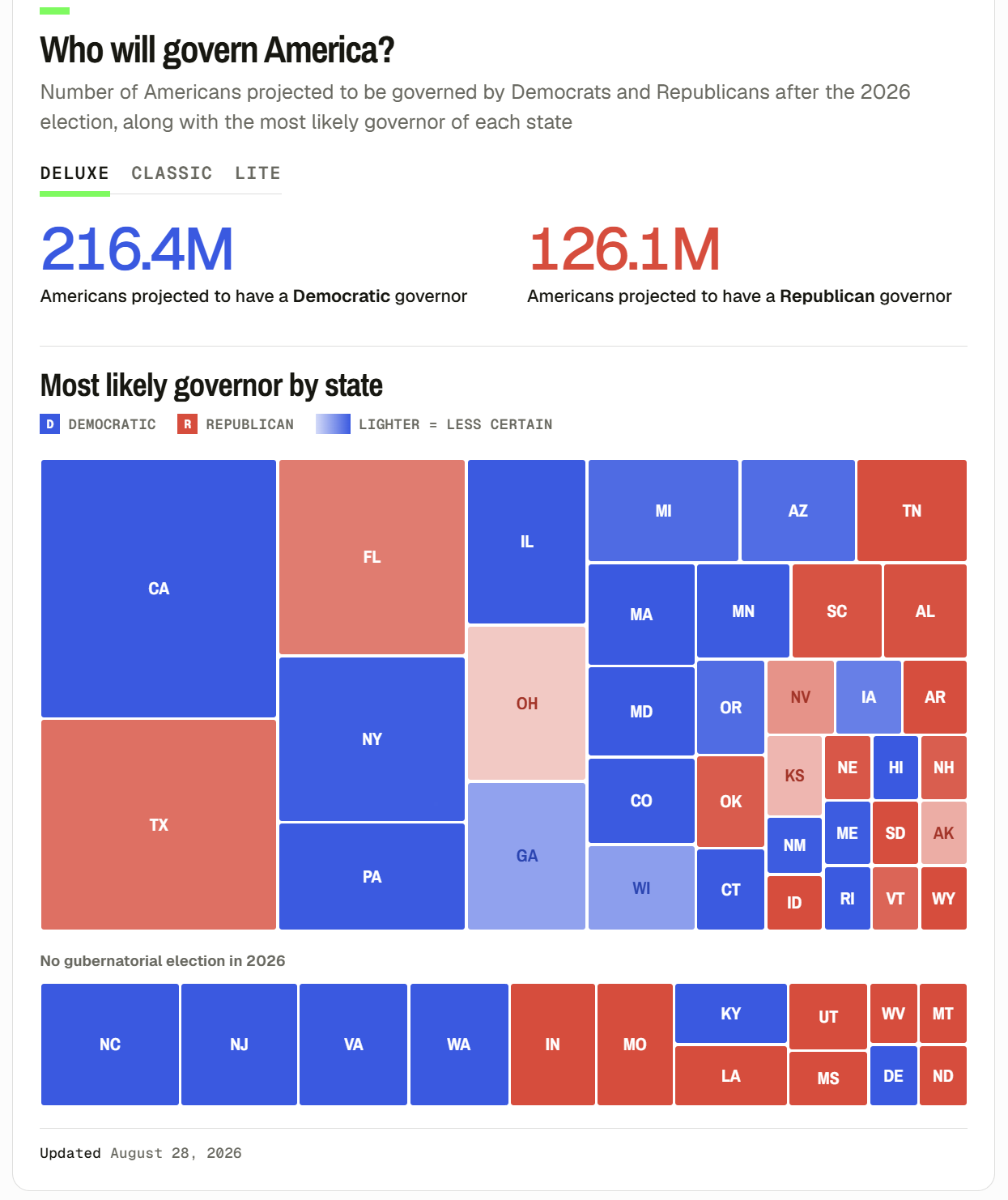
By the way, for my friends on the right who worry I’m too obsessed with intra-party fights among Democrats: This is why. Nate Silver thinks 60 percent of Americans—and American school children!—will be in states led by Democratic governors come January.
Another item we covered last week was New York State’s dubious “portrait of a graduate,” which my Fordham Institute colleague Meredith Coffey called “a disaster in the making.” Randy Squier, former superintendent of a small school district in the Hudson Valley, responded, in part to agree with Meredith’s concerns about academic rigor.
For 21 years as a superintendent, I lived in the world of Regents exams, graduation rates, course credits, and accountability measures. I understood their value and never believed academic knowledge was optional. But I also knew those measures were incomplete.
At Coxsackie-Athens, that realization helped drive our readiness work years before New York adopted a statewide portrait of a graduate. We knew students who had passed every required exam and accumulated every required credit but still struggled with independence, communication, collaboration, persistence, or navigating an unfamiliar problem. We also knew students whose readiness was much stronger than their test scores suggested.
That led us to a simple belief: Our kids are more than a test score. The important word is more, not instead of. Academic preparation, content knowledge, reading, writing, mathematics, science, and history all matter. The question is whether passing five Regents exams was ever sufficient evidence that a young person was ready for life after high school. I don’t believe it was.
Ah yes, the classic “both/and not either/or” argument! Which is fine as far as it goes—except that New York is not adding a portrait of a graduate to its Regents Exams system—it is subtracting the exams and replacing them with a portrait—and a vague, mushy one at that. Which creates the great moral hazard that students will now graduate from New York’s schools with neither the academic readiness the Regents measure nor the “durable skills” that portrait of a graduate advocates like Squier hold so dear.
Meanwhile, Nicholas Munyan-Penney and Aileen Ma bemoan the erosion of standards from coast to coast—including in Florida, where (as we’ve discussed) some districts are using the Classic Learning Test as a shortcut to high school graduation for their low-performing students, as well as other jurisdictions that are dropping proficiency cut scores and lowering graduation requirements as well. As Nicholas and Aileen write, these actions “spare adult feelings at the expense of students’ futures.”
Here’s what these moves really do: They hand school, district, and state leaders a false sense of accomplishment—a graduation rate gain to celebrate, an academic achievement boost to tout. But the gains are cooked books, not real learning. Students and their families are told they’re ready for college and career when many—especially students of color and students from low-income backgrounds—were never given the opportunities and support to actually get there.
Ugh, way to go folks!
Finally, let’s check in on the Head Start debate. By my estimate, about half of all ed policy wonks have written op-eds lambasting the Trump administration’s effort to deregulate the program into oblivion. I’m partial to my colleague Checker Finn’s take for a good overview and explanation of where it errs. Rick Hess wisely thought to ask the Trump administration official in charge of the program—Alex Adams—to respond. He made a pretty good case! Among the best tidbits:
Rick: What motivated these changes?
Alex: The most immediate reason is access. Regulations adopted in 2016 and 2024 contributed to rising per-student costs, which resulted in the loss of 277,658 slots for students from 2015 to 2025, according to a recent analysis by the assistant secretary for planning and evaluation at HHS. That’s a 29 percent decline in a decade. Supporters of those rules argued that fewer slots would be offset by higher quality for the families still served. But that same analysis found no substantial gains in quality, despite federal spending on the program outpacing inflation by double digits. Higher costs, no improvement in quality, and fewer children served: Our proposal is designed to reverse this dynamic.
And:
Rick: OK, so what’s the biggest thing that you think critics are getting wrong?
Alex: The biggest misconception is that flexibility is a mandate. If a local program likes its current operating model, this rule doesn’t require it to change. Some criticism also implicitly assumes that local Head Start directors, teachers, parents, and state regulators can’t be trusted to make responsible decisions without Washington prescribing every detail. These are some of the most capable and mission-driven people I’ve worked with. Our job is to hold programs accountable for results while giving them room to solve problems in ways that fit their communities.
As with so much in policy and in life, it does indeed come down to trust. And let’s be honest: It’s hard to trust the Trump administration regarding a program it proposed to eliminate, even if Alex himself seems well-intentioned.

Other edu-opinions worth your attention
Chad Aldeman, “Just Pay the Teachers?”
Alli Aldis, “Why Parents Choose a School”
Matt Gandal, “How Detroit Made Education Its Comeback Strategy”
Holly Korbey, “Evidence Is the Antidote in Education”
John Kristof, “We’re Talking About Enrollment Declines All Wrong”
Bruno Manno, “As Students Return, What Did Federal Pandemic Aid Accomplish?”
Robert Maranto, “In the Age of AI, What Should Schools Teach?”
Scott Marion, “How Reading Lists Can Improve Assessments”
Stephen J. Owens, “Want More Equitable School Funding? NBA Salary Caps Can Be a Model”
Caitlin Peartree and David Winston, “Are the Schools Ready? Ready for What?”
Andrew J. Rotherham, “Education got there first? The breakdown of traditional left-right delineations.”
Shane Vander Hart, “Rob Sand’s ‘Common Sense’ ESA Reforms Don’t Add Up”
Natalie Wexler, “How Should AI Be Used in Schools?”
Patrick J. Wolf, “Chronic absenteeism plagues our schools and society”

MJ Slaby shares limited good news from Indianapolis, where the school board unanimously voted to end its pandemic-era “no-zeros” policy. District leaders took feedback from teachers and shifted toward a “happy medium” where students must show some attempt at completing assignments to earn points.
—
Good news from Denver, too, where accountability seems to be working. Four schools at risk of closure made serious efforts to improve student outcomes, boosting their ratings enough to stay open and continue their good work.
—
Let’s make it a hat trick with good news from…(checks notes)…New York? “Mayor Zohran Mamdani is locked in an unlikely showdown with a powerful classroom ally: the New York City teachers union,” reports James Fanelli. The Democratic socialist mayor is taking on his own base, suing to stop a fiscally irresponsible bonus payout to school aides despite the union boss’s threat of “all-out war.”

Florida Attorney General James Uthmeier, perhaps in a misguided attempt to distract from the corruption allegations engulfing him and many others in the governor’s orbit, decided to take on the Catholic Church. He’s threatening to ban Catholic schools in the Sunshine State from its voucher program if they require vaccinations for their students, arguing that the bishops have “no legitimate religious reason” to deny religious exemptions. The current saber-rattling may be a culture war attention grab, but it raises important questions about how much control states should have over private schools accepting public funding for vouchers, and whether accepting the funds—and the rules—removes the qualities that make those private schools appealing to families in the first place.

It’s not too far a leap from Florida to Texas, where officials joined several other states in rejecting Alpha School’s attempt to open a charter program over concerns about its quality and student outcomes. However, the state will still let the public dollars continue to flow to Alpha’s private campuses through its expansive ESA program since academic outcomes aren’t part of the eligibility criteria for that funding stream. Expect more cases like this as the lines between public and private schools continue to blur.

Doug Harris writes in with his thoughts about last week’s question, “Will the Federal Scholarship Tax Credit really be a boon for public schools?”
Mike,
I think the public-school capture question isn’t the most interesting one, though I can see why you asked it.
Here’s a different question: Does this program make sense given how cumbersome it is?
Let’s divide the amount of funding likely to be provided by the amount of work SGOs, parents, and families are going to have to put into making it function. On that basis, this is shaping up to be almost silly. Thousands of SGOs are going to be created, all of which are going to have to spend time, and a share of the receipts, to educate donors and convince them to chip in. Then, the SGOs will have to create administrative systems to determine family eligibility and formulas for disbursing funds that are compliant with the policy. Then, someone, possibly both the SGOs and state agencies, will have to hire staff to determine whether everyone involved is complying. Then, donors are going to have to deal with this on their tax returns.
One possible response is: “Fine, SGOs, schools, and parents just won’t participate if it’s too much work.” That’s partially right, but they will participate so long as the benefits are larger than the costs. That still means enormous costs even for those who deem it worthwhile. So much for getting rid of the supposed “big, bloated bureaucracies.”
This seems worse than the FAFSA in most ways. Even if that form might be longer (hard to tell at this point), financial aid offices don’t have to find donors (yes, more expensive colleges have large development offices that do that, but that’s actually a tiny minority of colleges). Only a small number of recipients have to deal with this on their tax returns. And the FAFSA actually helps students afford to attend college—many couldn’t attend at all otherwise. All K–12 students, in contrast, can already go to school free of direct charge. The FSTC might allow more students to attend different kinds of schools or access some service that public schools mostly already provide, but the potential expansion of opportunity is much more limited.
In other ways, the program is like other charitable work. Non-profits solicit funding from potential donors and some do turn around and redistribute that money to individuals. That is also very time-intensive, but charities can fill in the gaps that government social safety nets don’t meet or that civil society deems important separate from government action.
Even if we concede the highly debatable point that the FSTC fills such a need, that just raises the question: Why not just have people donate to increase the child tax credit and distribute money to families that way? That would probably raise more money, still provide funds disproportionately to lower-income families, and involve no new systems.
I wonder, is there any other program that will create greater administrative costs and burdens than this one, relative to the good it will do and relative to the alternatives available? I’m sure there are competitors out there and they will be the exceptions that prove the rule.
Doug’s not wrong—it’s a sludgy, cockamamie policy design. But I still hope states opt into it, if for no other reason than to allow low-income and working-class families the chance to choose Catholic schools, and other high-quality private schools, if that’s what they desire for their kids.
See ya next week, folks.
Mike
Sign up to receive this newsletter in your inbox, usually on Friday mornings. SCHOOLED is free, but a few linked articles may be paywalled by other publications.
Disparities-first thinking is just worse for all students, and it makes no sense to compromise here. The number of students who don't need more severe disciplinary measures is vastly larger than the ones that do, and so refusing to enforce because of differences across small numbers is just bananas as a matter of public policy. We should shift the conversation to the disparate impact of disorderly/unsafe classrooms.